
BoxPlot draws box plots or bar plots (mean ± error bars) with extensive
customisation options. Supports jittered or beeswarm points, paired
observations with connecting lines, trend lines, statistical test
annotations (pairwise or omnibus), background stripes, reference lines,
point highlighting, and custom summary statistic overlays.
This is the public API — it delegates to BoxViolinPlot
with base = "box" or base = "bar", which in turn dispatches
to BoxViolinPlotAtomic for each split_by level.
ViolinPlot draws violin plots with extensive customisation options. Supports jittered
or beeswarm points, box plot overlays, trend lines, statistical test
annotations, background stripes, reference lines, point highlighting,
and custom summary statistic overlays.
This is the public API — it delegates to BoxViolinPlot
with base = "violin", which dispatches to
BoxViolinPlotAtomic for each split_by level.
BeeswarmPlot draws beeswarm plots — points arranged by the beeswarm algorithm to
avoid overlap while displaying the distribution density. This is a
convenience wrapper that delegates to BoxViolinPlot with
base = "none" and add_beeswarm = TRUE.
Requires the ggbeeswarm package. To get a beeswarm plot WITH a
box plot, use BeeswarmPlot(..., add_box = TRUE). To get a violin
plot with beeswarm points, use ViolinPlot(..., add_beeswarm = TRUE).
Usage
BoxPlot(
  data,
  x,
  x_sep = "_",
  y = NULL,
  base = c("box", "bar"),
  in_form = c("long", "wide"),
  split_by = NULL,
  split_by_sep = "_",
  symnum_args = NULL,
  sort_x = NULL,
  flip = FALSE,
  keep_empty = FALSE,
  keep_na = FALSE,
  group_by = NULL,
  group_by_sep = "_",
  group_name = NULL,
  paired_by = NULL,
  x_text_angle = ifelse(isTRUE(flip), 0, 45),
  step_increase = 0.1,
  fill_mode = ifelse(!is.null(group_by), "dodge", "x"),
  palreverse = FALSE,
  position_dodge_preserve = "total",
  theme = "theme_this",
  theme_args = list(),
  palette = "Paired",
  palcolor = NULL,
  alpha = 1,
  aspect.ratio = NULL,
  legend.position = "right",
  legend.direction = "vertical",
  add_point = FALSE,
  pt_color = if (isTRUE(add_beeswarm)) NULL else "grey30",
  pt_size = NULL,
  pt_alpha = 1,
  jitter_width = NULL,
  jitter_height = 0,
  stack = FALSE,
  y_max = NULL,
  y_min = NULL,
  y_brackets = NULL,
  add_beeswarm = FALSE,
  beeswarm_method = "swarm",
  beeswarm_cex = 1,
  beeswarm_priority = "ascending",
  beeswarm_dodge = 0.9,
  add_trend = FALSE,
  trend_color = NULL,
  trend_linewidth = 1,
  trend_ptsize = 2,
  add_stat = NULL,
  stat_name = NULL,
  stat_color = "black",
  stat_size = 1,
  stat_stroke = 1,
  stat_shape = 25,
  add_errorbar = "SEM",
  errorbar_color = "grey20",
  errorbar_width = 0.4,
  errorbar_linewidth = 0.6,
  add_bg = FALSE,
  bg_palette = "stripe",
  bg_palcolor = NULL,
  bg_alpha = 0.2,
  add_line = NULL,
  line_color = "red2",
  line_width = 0.6,
  line_type = 2,
  highlight = NULL,
  highlight_color = "red2",
  highlight_size = 1,
  highlight_alpha = 1,
  comparisons = NULL,
  ref_group = NULL,
  pairwise_method = "wilcox.test",
  multiplegroup_comparisons = FALSE,
  multiple_method = "kruskal.test",
  sig_label = "p.format",
  sig_labelsize = 3.5,
  hide_ns = FALSE,
  facet_by = NULL,
  facet_scales = "fixed",
  facet_ncol = NULL,
  facet_nrow = NULL,
  facet_byrow = TRUE,
  title = NULL,
  subtitle = NULL,
  xlab = NULL,
  ylab = NULL,
  seed = 8525,
  combine = TRUE,
  nrow = NULL,
  ncol = NULL,
  byrow = TRUE,
  axes = NULL,
  axis_titles = axes,
  guides = NULL,
  ...
)

ViolinPlot(
  data,
  x,
  x_sep = "_",
  y = NULL,
  in_form = c("long", "wide"),
  split_by = NULL,
  split_by_sep = "_",
  symnum_args = NULL,
  sort_x = NULL,
  flip = FALSE,
  keep_empty = FALSE,
  keep_na = FALSE,
  group_by = NULL,
  group_by_sep = "_",
  group_name = NULL,
  paired_by = NULL,
  x_text_angle = ifelse(isTRUE(flip), 0, 45),
  step_increase = 0.1,
  fill_mode = ifelse(!is.null(group_by), "dodge", "x"),
  palreverse = FALSE,
  position_dodge_preserve = "total",
  theme = "theme_this",
  theme_args = list(),
  palette = "Paired",
  palcolor = NULL,
  alpha = 1,
  aspect.ratio = NULL,
  legend.position = "right",
  legend.direction = "vertical",
  add_point = FALSE,
  pt_color = if (isTRUE(add_beeswarm)) NULL else "grey30",
  pt_size = NULL,
  pt_alpha = 1,
  jitter_width = NULL,
  jitter_height = 0,
  stack = FALSE,
  y_max = NULL,
  y_min = NULL,
  y_brackets = NULL,
  add_beeswarm = FALSE,
  beeswarm_method = "swarm",
  beeswarm_cex = 1,
  beeswarm_priority = "ascending",
  beeswarm_dodge = 0.9,
  add_box = FALSE,
  box_color = "black",
  box_width = 0.1,
  box_ptsize = 2.5,
  add_trend = FALSE,
  trend_color = NULL,
  trend_linewidth = 1,
  trend_ptsize = 2,
  add_stat = NULL,
  stat_name = NULL,
  stat_color = "black",
  stat_size = 1,
  stat_stroke = 1,
  stat_shape = 25,
  add_bg = FALSE,
  bg_palette = "stripe",
  bg_palcolor = NULL,
  bg_alpha = 0.2,
  add_line = NULL,
  line_color = "red2",
  line_width = 0.6,
  line_type = 2,
  highlight = NULL,
  highlight_color = "red2",
  highlight_size = 1,
  highlight_alpha = 1,
  comparisons = NULL,
  ref_group = NULL,
  pairwise_method = "wilcox.test",
  multiplegroup_comparisons = FALSE,
  multiple_method = "kruskal.test",
  sig_label = "p.format",
  sig_labelsize = 3.5,
  hide_ns = FALSE,
  facet_by = NULL,
  facet_scales = "fixed",
  facet_ncol = NULL,
  facet_nrow = NULL,
  facet_byrow = TRUE,
  title = NULL,
  subtitle = NULL,
  xlab = NULL,
  ylab = NULL,
  seed = 8525,
  combine = TRUE,
  nrow = NULL,
  ncol = NULL,
  byrow = TRUE,
  axes = NULL,
  axis_titles = axes,
  guides = NULL,
  ...
)

BeeswarmPlot(
  data,
  x,
  x_sep = "_",
  y = NULL,
  in_form = c("long", "wide"),
  split_by = NULL,
  split_by_sep = "_",
  symnum_args = NULL,
  sort_x = NULL,
  flip = FALSE,
  keep_empty = FALSE,
  keep_na = FALSE,
  group_by = NULL,
  group_by_sep = "_",
  group_name = NULL,
  paired_by = NULL,
  x_text_angle = ifelse(isTRUE(flip), 0, 45),
  step_increase = 0.1,
  fill_mode = ifelse(!is.null(group_by), "dodge", "x"),
  palreverse = FALSE,
  theme = "theme_this",
  theme_args = list(),
  palette = "Paired",
  palcolor = NULL,
  alpha = 1,
  aspect.ratio = NULL,
  legend.position = "right",
  legend.direction = "vertical",
  pt_color = NULL,
  pt_size = NULL,
  pt_alpha = 1,
  position_dodge_preserve = "total",
  jitter_width = NULL,
  jitter_height = 0,
  stack = FALSE,
  y_max = NULL,
  y_min = NULL,
  y_brackets = NULL,
  add_violin = FALSE,
  beeswarm_method = "swarm",
  beeswarm_cex = 1,
  beeswarm_priority = "ascending",
  beeswarm_dodge = 0.9,
  add_box = FALSE,
  box_color = "black",
  box_width = 0.1,
  box_ptsize = 2.5,
  add_trend = FALSE,
  trend_color = NULL,
  trend_linewidth = 1,
  trend_ptsize = 2,
  add_stat = NULL,
  stat_name = NULL,
  stat_color = "black",
  stat_size = 1,
  stat_stroke = 1,
  stat_shape = 25,
  add_bg = FALSE,
  bg_palette = "stripe",
  bg_palcolor = NULL,
  bg_alpha = 0.2,
  add_line = NULL,
  line_color = "red2",
  line_width = 0.6,
  line_type = 2,
  highlight = NULL,
  highlight_color = "red2",
  highlight_size = 1,
  highlight_alpha = 1,
  comparisons = NULL,
  ref_group = NULL,
  pairwise_method = "wilcox.test",
  multiplegroup_comparisons = FALSE,
  multiple_method = "kruskal.test",
  sig_label = "p.format",
  sig_labelsize = 3.5,
  hide_ns = FALSE,
  facet_by = NULL,
  facet_scales = "fixed",
  facet_ncol = NULL,
  facet_nrow = NULL,
  facet_byrow = TRUE,
  title = NULL,
  subtitle = NULL,
  xlab = NULL,
  ylab = NULL,
  seed = 8525,
  combine = TRUE,
  nrow = NULL,
  ncol = NULL,
  byrow = TRUE,
  axes = NULL,
  axis_titles = axes,
  guides = NULL,
  ...
)
Arguments
- data
A data frame.
- x
A character string specifying the column name of the data frame to plot for the x-axis.
- x_sep
A character string to join multiple
xcolumns. Default"_".- y
A character string specifying the column name of the data frame to plot for the y-axis.
- base
A character string:
"box"(default) or"bar". Bar plots show group means with optional error bars.- in_form
A character string:
"long"(default) or"wide". In wide form,xcolumns are pivoted to long format.- split_by
The column(s) to split the data by for separate sub-plots.
- split_by_sep
Separator for concatenated
split_bycolumns.- symnum_args
A list of arguments passed to
symnumfor symbolic p-value coding.- sort_x
An R expression string (e.g.,
"mean(y)") to order x-axis categories. DefaultNULLkeeps the original order. Whenkeep_empty_xisTRUE, empty levels are placed last.- flip
Logical; if
TRUE, swap the x and y axes.- keep_empty
One of FALSE, TRUE and "level". It can also take a named list to specify different behavior for different columns. Without a named list, the behavior applies to the categorical/character columns used on the plot, for example, the
x,group_by,fill_by, etc.FALSE(default): Drop empty factor levels from the data before plotting.TRUE: Keep empty factor levels and show them as a separate category in the plot."level": Keep empty factor levels, but do not show them in the plot. But they will be assigned colors from the palette to maintain consistency across multiple plots. Alias:levels
- keep_na
A logical value or a character to replace the NA values in the data. It can also take a named list to specify different behavior for different columns. If TRUE or NA, NA values will be replaced with NA. If FALSE, NA values will be removed from the data before plotting. If a character string is provided, NA values will be replaced with the provided string. If a named vector/list is provided, the names should be the column names to apply the behavior to, and the values should be one of TRUE, FALSE, or a character string. Without a named vector/list, the behavior applies to categorical/character columns used on the plot, for example, the
x,group_by,fill_by, etc.- group_by
Columns to group the data for plotting For those plotting functions that do not support multiple groups, They will be concatenated into one column, using
group_by_sepas the separator- group_by_sep
The separator for multiple group_by columns. See
group_by- group_name
A character string for the dodge legend title.
- paired_by
A character string naming a column that identifies paired observations. Forces
add_point = TRUEand connects paired observations with lines.- x_text_angle
A numeric value specifying the angle of the x-axis text.
- step_increase
Fractional step increase for stacking significance brackets when multiple comparisons exist.
- fill_mode
A character string controlling fill colour mapping:
"dodge"(fill bygroup_by, discrete),"x"(fill by x-axis categories, discrete),"mean"or"median"(fill by pre-computed statistic, continuous gradient).- palreverse
A logical value indicating whether to reverse the palette. Default is FALSE.
- position_dodge_preserve
Passed to
position_dodge():"total"preserves the overall group width;"single"preserves individual element width.- theme
A character string or a theme class (i.e. ggplot2::theme_classic) specifying the theme to use. Default is "theme_this".
- theme_args
A list of arguments to pass to the theme function.
- palette
A character string specifying the palette to use. A named list or vector can be used to specify the palettes for different
split_byvalues.- palcolor
A character string specifying the color to use in the palette. A named list can be used to specify the colors for different
split_byvalues. If some values are missing, the values from the palette will be used (palcolor will be NULL for those values).- alpha
A numeric value specifying the transparency of the plot.
- aspect.ratio
A numeric value specifying the aspect ratio of the plot.
- legend.position
A character string specifying the position of the legend. if
waiver(), for single groups, the legend will be "none", otherwise "right".- legend.direction
A character string specifying the direction of the legend.
- add_point
Logical; add jittered or beeswarm points to the plot.
- pt_color
Colour of the points. When
add_beeswarm = TRUEandpt_colorisNULL, points are coloured by the fill variable.- pt_size
Numeric size of the points. Default computed from data size:
min(3000 / nrow(data), 0.6).- pt_alpha
Numeric transparency of the points.
- jitter_width
Numeric width of the jitter. Defaults to
0.5, but set to0whenpaired_byis provided.- jitter_height
Numeric height of the jitter. Default
0.- stack
Logical; stack facetted panels in a compact layout with shared strip labels.
- y_max, y_min
Numeric y-axis limits, or quantile notation strings (e.g.,
"q95"for the 95th percentile,"q5"for the 5th percentile).- y_brackets
Numeric y-axis position for significance brackets (or p-value labels for multiple comparisons). If NULL, the brackets are placed above the maximum y-value.
- add_beeswarm
Logical; use
ggbeeswarm::geom_beeswarm()for non-overlapping point layout instead of jitter. Requires theggbeeswarmpackage.- beeswarm_method
Beeswarm layout method:
"swarm","compactswarm","hex","square", or"center".- beeswarm_cex
Numeric scaling for point spacing. Larger values spread points more.
- beeswarm_priority
Point layout priority:
"ascending","descending","density", or"random".- beeswarm_dodge
Numeric dodge width for beeswarm points when
group_byis provided. Default0.9.- add_trend
Logical; add trend lines connecting group medians.
- trend_color
Colour of the trend line. When
NULLandgroup_byis present, lines are coloured per group.- trend_linewidth
Width of the trend line.
- trend_ptsize
Size of the trend line points.
- add_stat
A summary function (e.g.,
mean,median) to display as a point with a shape legend entry.- stat_name
Legend title for the stat summary shape.
- stat_color
Colour of the stat summary point.
- stat_size
Size of the stat summary point.
- stat_stroke
Stroke width of the stat summary point.
- stat_shape
Shape (an integer) for the stat summary point. Uses
scale_shape_identity()so the shape is rendered directly.- add_errorbar
Type of error bars for bar plots. See Details.
- errorbar_color, errorbar_width, errorbar_linewidth
Error bar appearance controls.
- add_bg
Logical; add alternating background stripes.
- bg_palette
Palette for the background stripes.
- bg_palcolor
Custom colours for the background stripes.
- bg_alpha
Alpha transparency for the background stripes.
- add_line
A numeric y-intercept for a horizontal reference line.
- line_color
Colour of the reference line.
- line_width
Width of the reference line.
- line_type
Linetype of the reference line.
- highlight
A specification of points to highlight:
TRUE(all), a numeric index vector, a logical expression string, or a character vector of row names.- highlight_color
Colour of highlighted points.
- highlight_size
Size of highlighted points.
- highlight_alpha
Alpha of highlighted points.
- comparisons
A logical value (
TRUEfor all pairs) or a list of two-element vectors specifying pairwise comparisons. Only available whenfill_mode = "dodge"(i.e.,group_byis present).- ref_group
A character string specifying the reference group for comparisons.
- pairwise_method
Method for pairwise tests. Default
"wilcox.test".- multiplegroup_comparisons
Logical; perform an omnibus test (e.g., Kruskal-Wallis) across all groups.
- multiple_method
Method for the omnibus test. Default
"kruskal.test".- sig_label
Label format for significance annotations. For pairwise comparisons:
"p.format","p.signif", or a glue template (e.g.,"p = {p}"). For multiple-group tests:"p.format"or"p.signif".- sig_labelsize
Size of the significance label text.
- hide_ns
Logical; hide non-significant comparison labels.
- facet_by
A character string specifying the column name of the data frame to facet the plot. Otherwise, the data will be split by
split_byand generate multiple plots and combine them into one usingpatchwork::wrap_plots- facet_scales
Whether to scale the axes of facets. Default is "fixed" Other options are "free", "free_x", "free_y". See
ggplot2::facet_wrap- facet_ncol
A numeric value specifying the number of columns in the facet. When facet_by is a single column and facet_wrap is used.
- facet_nrow
A numeric value specifying the number of rows in the facet. When facet_by is a single column and facet_wrap is used.
- facet_byrow
A logical value indicating whether to fill the plots by row. Default is TRUE.
- title
A character string specifying the title of the plot. A function can be used to generate the title based on the default title. This is useful when split_by is used and the title needs to be dynamic.
- subtitle
A character string specifying the subtitle of the plot.
- xlab
A character string specifying the x-axis label.
- ylab
A character string specifying the y-axis label.
- seed
A numeric seed for reproducibility.
- combine
Logical; when
TRUE(default), returns a combinedpatchworkobject. WhenFALSE, returns a named list ofggplotobjects.- ncol, nrow
Integer number of columns / rows for the combined layout.
- byrow
Logical; fill the combined layout by row (default
TRUE).- axes, axis_titles
Character strings for axis handling in the combined layout.
- guides
Character string for legend collection across panels.
- ...
Additional arguments.
- add_box
Logical; overlay a box plot on the primary geometry. Mutually exclusive with
base = "box"andbase = "bar".- box_color
Colour of the overlaid box plot outline and fill.
- box_width
Width of the overlaid box plot.
- box_ptsize
Size of the median point in the overlaid box plot.
- add_violin
Logical; whether to add a violin plot behind the beeswarm points. Not supported — the function will stop with an error directing you to use
ViolinPlot(..., add_beeswarm = TRUE)instead.
Value
A ggplot object, a patchwork object, or a named list
of ggplot objects (when combine = FALSE), each with
height and width attributes in inches.
Bar plots (base = "bar")
When base = "bar", bars display group means with optional error
bars. add_errorbar controls the error bar type:
"SEM"(default) — standard error of the mean."SD"— standard deviation."CI"or"CI95"— 95\"none"— no error bars.
Error bars are computed via a custom stat_summary(fun.data = ...)
that handles per-group mean, SD, and sample size.
Examples
# \donttest{
set.seed(8525)
data <- data.frame(
x = rep(LETTERS[1:8], each = 40),
y = c(rnorm(160), rnorm(160, mean = 1)),
group1 = sample(c("g1", "g2"), 320, replace = TRUE),
group2 = sample(c("h1", "h2", "h3", "h4"), 320, replace = TRUE)
)
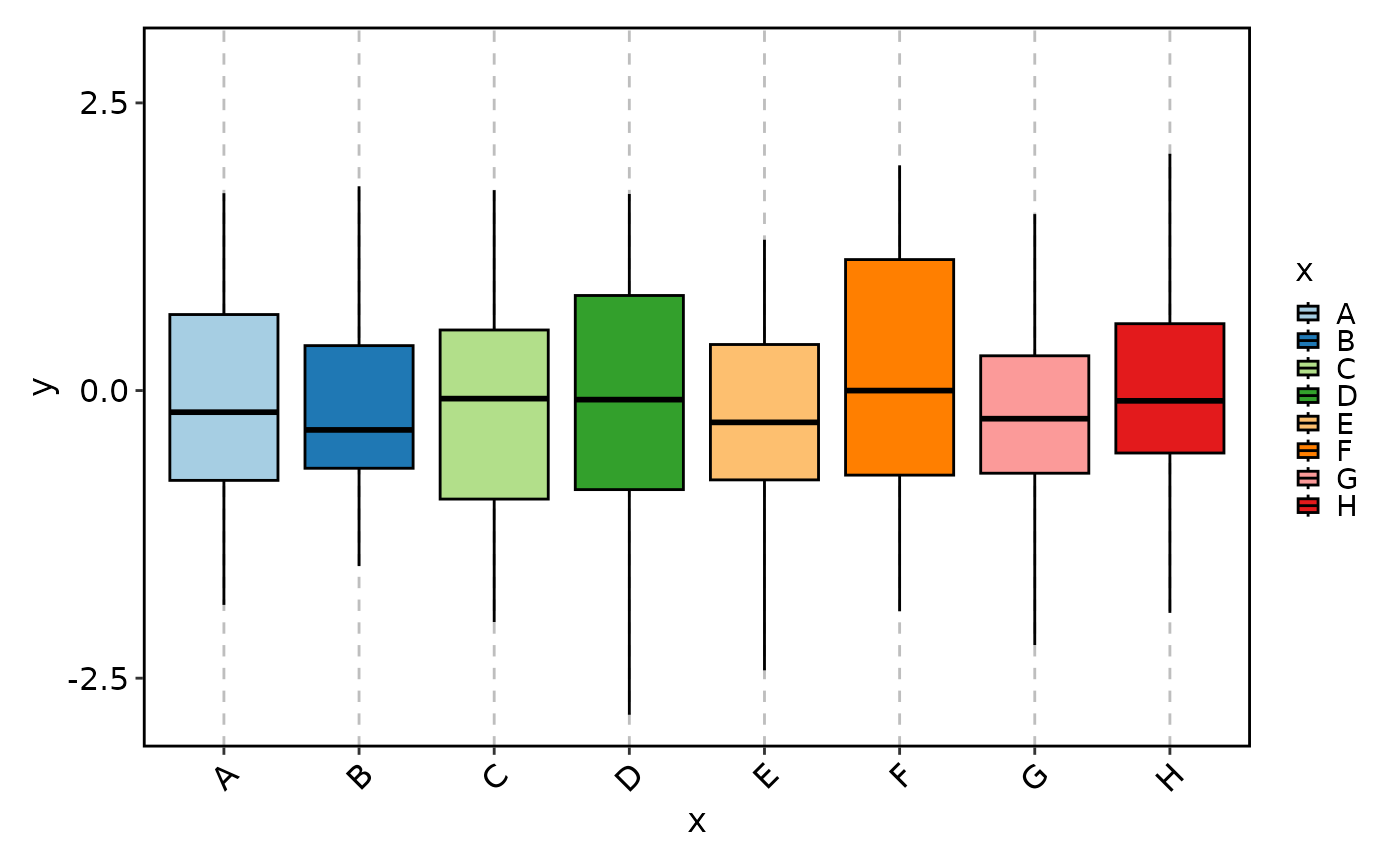
# Basic box plot
BoxPlot(data, x = "x", y = "y")
 # With beeswarm points
BoxPlot(data, x = "x", y = "y", add_beeswarm = TRUE, pt_color = "grey30")
# With beeswarm points
BoxPlot(data, x = "x", y = "y", add_beeswarm = TRUE, pt_color = "grey30")
 # Stacked + flipped + faceted
BoxPlot(data,
x = "x", y = "y",
stack = TRUE, flip = TRUE, facet_by = "group1",
add_bg = TRUE, bg_palette = "Paired")
# Stacked + flipped + faceted
BoxPlot(data,
x = "x", y = "y",
stack = TRUE, flip = TRUE, facet_by = "group1",
add_bg = TRUE, bg_palette = "Paired")
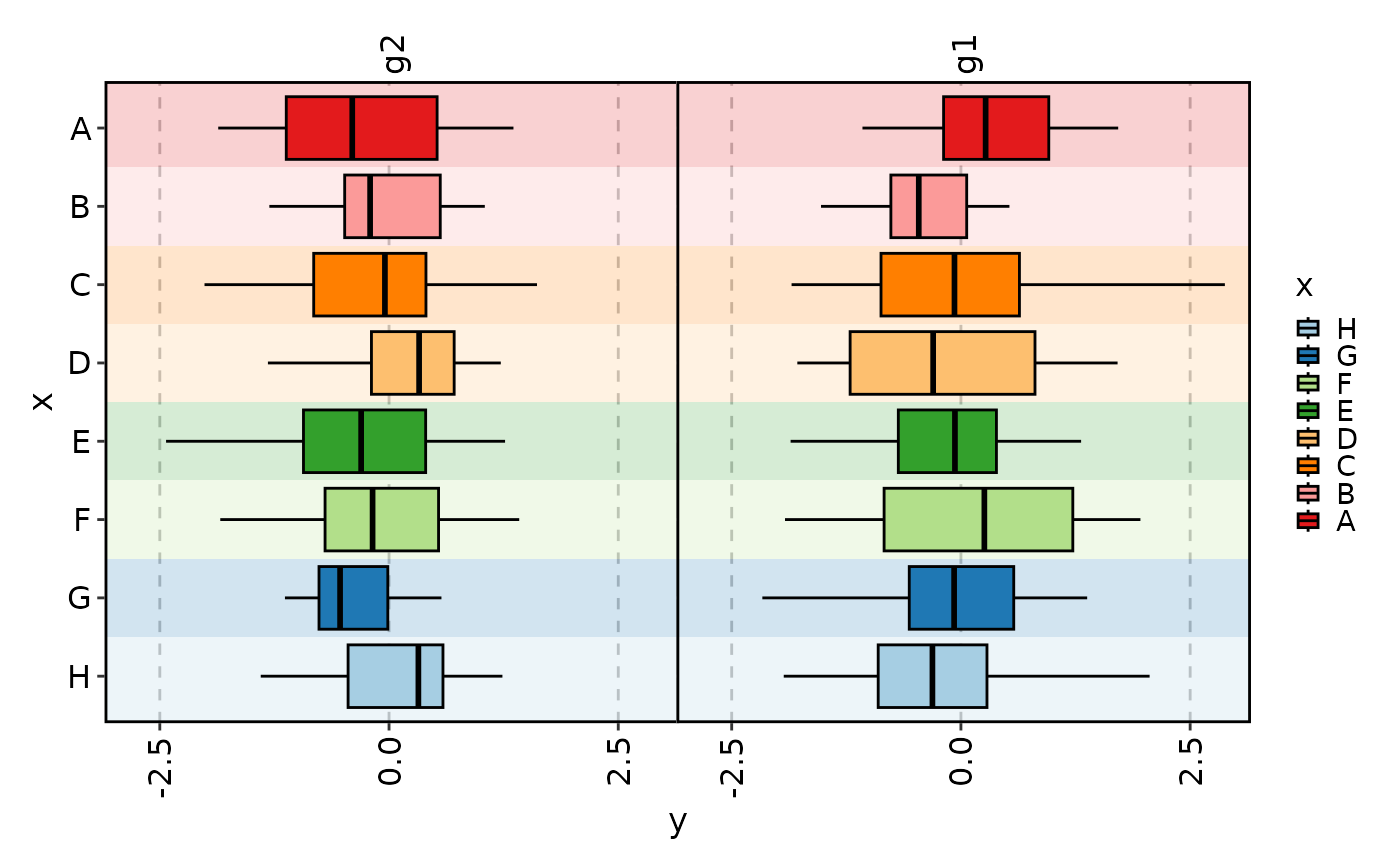
 # Stacked + flipped + split_by with per-split colours
BoxPlot(data,
x = "x", y = "y",
stack = TRUE, flip = TRUE, split_by = "group1",
add_bg = TRUE, bg_palette = "Paired",
palcolor = list(g1 = c("red", "blue"), g2 = c("blue", "red")))
# Stacked + flipped + split_by with per-split colours
BoxPlot(data,
x = "x", y = "y",
stack = TRUE, flip = TRUE, split_by = "group1",
add_bg = TRUE, bg_palette = "Paired",
palcolor = list(g1 = c("red", "blue"), g2 = c("blue", "red")))
 # sort_x — order by mean(y)
data <- data.frame(
x = factor(rep(LETTERS[1:5], each = 40),
levels = c(LETTERS[1:2], "unused", LETTERS[3:5])),
y = c(rnorm(40, mean = 5), rnorm(40, mean = 4), rnorm(40, mean = 3),
rnorm(40, mean = 2), rnorm(40, mean = 1))
)
BoxPlot(data, x = "x", y = "y", sort_x = "mean(y)", keep_empty = TRUE)
# sort_x — order by mean(y)
data <- data.frame(
x = factor(rep(LETTERS[1:5], each = 40),
levels = c(LETTERS[1:2], "unused", LETTERS[3:5])),
y = c(rnorm(40, mean = 5), rnorm(40, mean = 4), rnorm(40, mean = 3),
rnorm(40, mean = 2), rnorm(40, mean = 1))
)
BoxPlot(data, x = "x", y = "y", sort_x = "mean(y)", keep_empty = TRUE)
 BoxPlot(data, x = "x", y = "y", sort_x = "mean(-y)", keep_empty = TRUE)
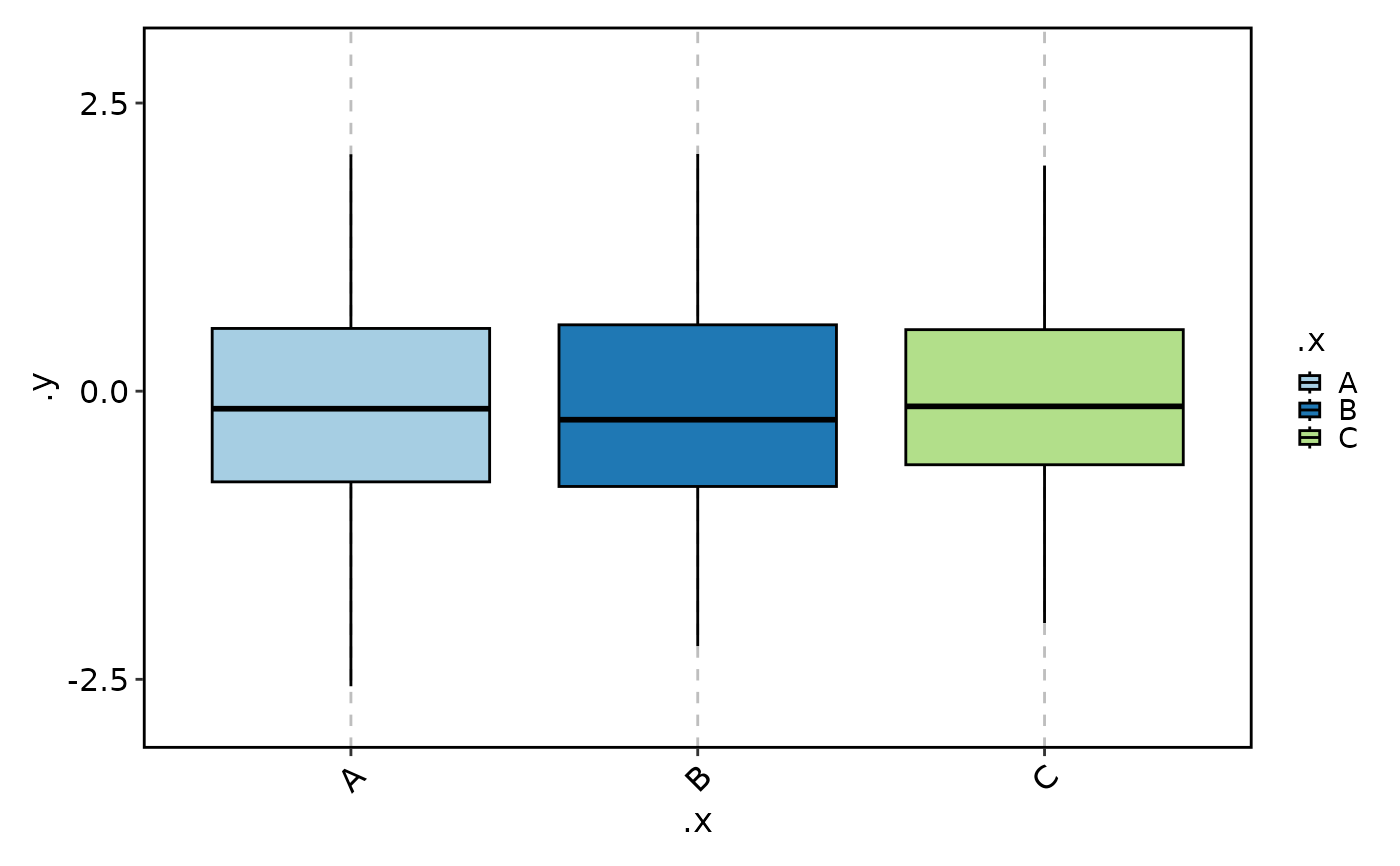
 # Wide-form data
data_wide <- data.frame(A = rnorm(100), B = rnorm(100), C = rnorm(100))
BoxPlot(data_wide, x = c("A", "B", "C"), in_form = "wide")
# Wide-form data
data_wide <- data.frame(A = rnorm(100), B = rnorm(100), C = rnorm(100))
BoxPlot(data_wide, x = c("A", "B", "C"), in_form = "wide")
 # Paired observations with connecting lines and paired test
paired_data <- data.frame(
subject = rep(paste0("s", 1:10), each = 2),
visit = rep(c("pre", "post"), times = 10),
value = rnorm(20))
BoxPlot(paired_data,
x = "visit", y = "value", comparisons = TRUE,
paired_by = "subject", add_point = TRUE)
# Paired observations with connecting lines and paired test
paired_data <- data.frame(
subject = rep(paste0("s", 1:10), each = 2),
visit = rep(c("pre", "post"), times = 10),
value = rnorm(20))
BoxPlot(paired_data,
x = "visit", y = "value", comparisons = TRUE,
paired_by = "subject", add_point = TRUE)
 # Paired + grouped
paired_group_data <- data.frame(
subject = rep(paste0("s", 1:6), each = 2),
x = rep(c("A", "B"), each = 6),
group = rep(c("before", "after"), times = 6),
value = rnorm(12))
BoxPlot(paired_group_data,
x = "x", y = "value",
paired_by = "subject", group_by = "group",
comparisons = TRUE, pt_size = 3, pt_color = "red")
#> Warning: Forcing 'add_point' = TRUE when 'paired_by' is provided.
#> Warning: [Box/Violin/BeeswarmPlot] Some pairwise comparisons may fail due to insufficient data points or variability. Adjusting data to ensure valid comparisons.
# Paired + grouped
paired_group_data <- data.frame(
subject = rep(paste0("s", 1:6), each = 2),
x = rep(c("A", "B"), each = 6),
group = rep(c("before", "after"), times = 6),
value = rnorm(12))
BoxPlot(paired_group_data,
x = "x", y = "value",
paired_by = "subject", group_by = "group",
comparisons = TRUE, pt_size = 3, pt_color = "red")
#> Warning: Forcing 'add_point' = TRUE when 'paired_by' is provided.
#> Warning: [Box/Violin/BeeswarmPlot] Some pairwise comparisons may fail due to insufficient data points or variability. Adjusting data to ensure valid comparisons.
 # keep_na and keep_empty examples
data <- data.frame(
x = factor(rep(c(LETTERS[1:3], NA, LETTERS[5:8]), each = 40),
levels = c(LETTERS[1:8])),
y = c(rnorm(160), rnorm(160, mean = 1)),
group1 = sample(c("g1", "g2"), 320, replace = TRUE),
group2 = factor(sample(c("h1", NA, "h3", "h4"), 320, replace = TRUE),
levels = c("h1", "h2", "h3", "h4")))
BoxPlot(data, x = "x", y = "y")
# keep_na and keep_empty examples
data <- data.frame(
x = factor(rep(c(LETTERS[1:3], NA, LETTERS[5:8]), each = 40),
levels = c(LETTERS[1:8])),
y = c(rnorm(160), rnorm(160, mean = 1)),
group1 = sample(c("g1", "g2"), 320, replace = TRUE),
group2 = factor(sample(c("h1", NA, "h3", "h4"), 320, replace = TRUE),
levels = c("h1", "h2", "h3", "h4")))
BoxPlot(data, x = "x", y = "y")
 BoxPlot(data, x = "x", y = "y", keep_na = TRUE, keep_empty = TRUE)
 BoxPlot(data, x = "x", y = "y", keep_na = TRUE, keep_empty = TRUE,
facet_by = "group2")
BoxPlot(data, x = "x", y = "y", keep_na = TRUE, keep_empty = TRUE,
facet_by = "group2")
 BoxPlot(data, x = "x", y = "y", keep_na = TRUE, keep_empty = 'level')
 BoxPlot(data, x = "x", y = "y", group_by = "group2")
 BoxPlot(data, x = "x", y = "y", group_by = "group2",
keep_na = TRUE, keep_empty = TRUE)
BoxPlot(data, x = "x", y = "y", group_by = "group2",
keep_na = TRUE, keep_empty = TRUE)
 BoxPlot(data, x = "x", y = "y", group_by = "group2",
keep_na = TRUE, keep_empty = 'level')
BoxPlot(data, x = "x", y = "y", group_by = "group2",
keep_na = TRUE, keep_empty = 'level')
 # Per-column keep_na / keep_empty
BoxPlot(data, x = "x", y = "y", group_by = "group2",
keep_na = list(x = TRUE, group2 = FALSE),
keep_empty = list(x = FALSE, group2 = TRUE))
# Per-column keep_na / keep_empty
BoxPlot(data, x = "x", y = "y", group_by = "group2",
keep_na = list(x = TRUE, group2 = FALSE),
keep_empty = list(x = FALSE, group2 = TRUE))
 # Bar plot (base = "bar")
data$y <- abs(data$y)
BoxPlot(data, x = "x", y = "y", base = "bar")
# Bar plot (base = "bar")
data$y <- abs(data$y)
BoxPlot(data, x = "x", y = "y", base = "bar")
 BoxPlot(data, x = "x", y = "y", base = "bar", add_errorbar = "SD")
 BoxPlot(data, x = "x", y = "y", base = "bar", add_errorbar = "CI95")
 BoxPlot(data, x = "x", y = "y", base = "bar", add_errorbar = "none")
 BoxPlot(data, x = "x", y = "y", base = "bar", group_by = "group1")
 BoxPlot(data, x = "x", y = "y", base = "bar", add_point = TRUE)
 BoxPlot(data, x = "x", y = "y", base = "bar",
fill_mode = "mean", palette = "Blues")
BoxPlot(data, x = "x", y = "y", base = "bar",
fill_mode = "mean", palette = "Blues")
 # }
# \donttest{
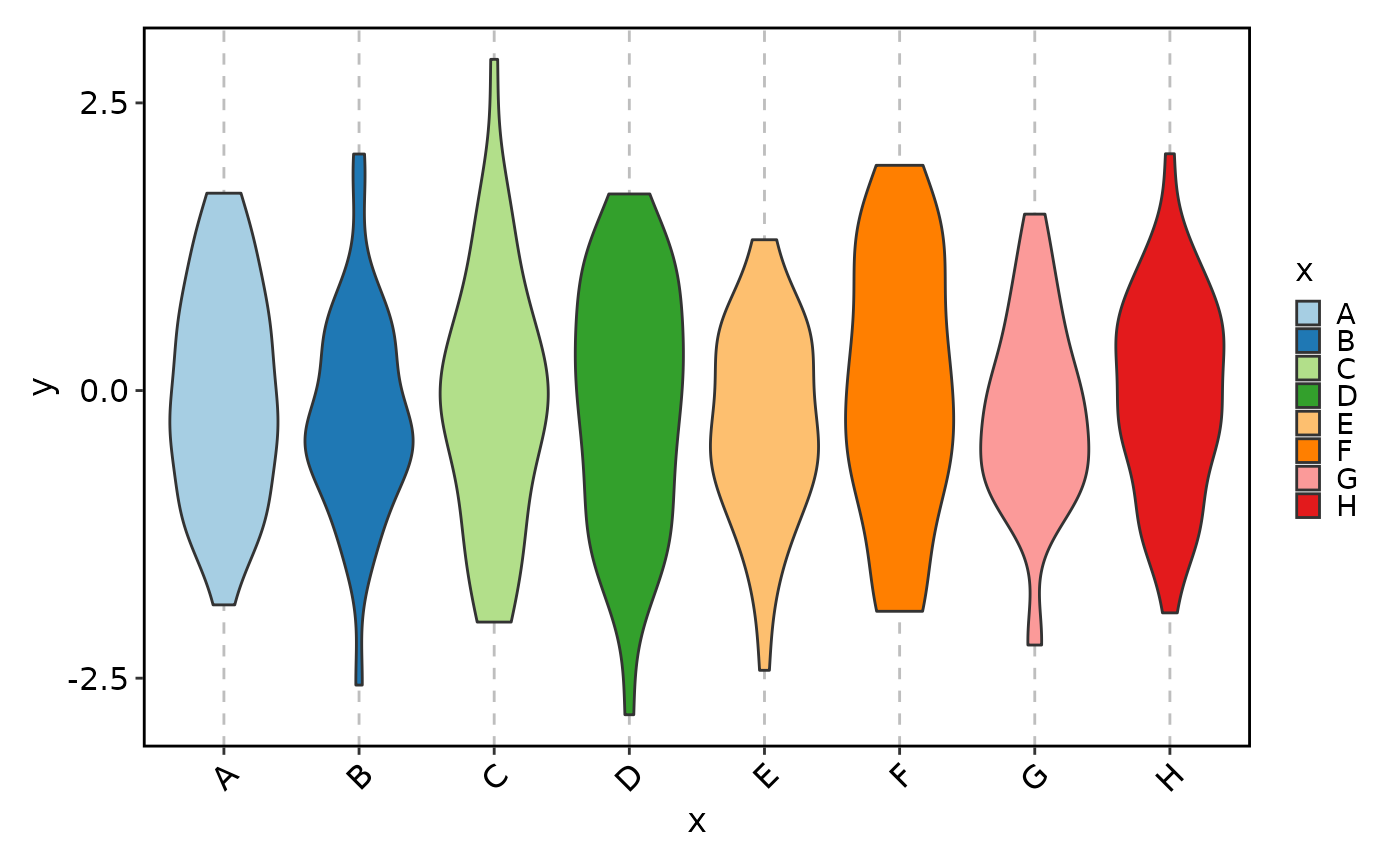
ViolinPlot(data, x = "x", y = "y")
# }
# \donttest{
ViolinPlot(data, x = "x", y = "y")
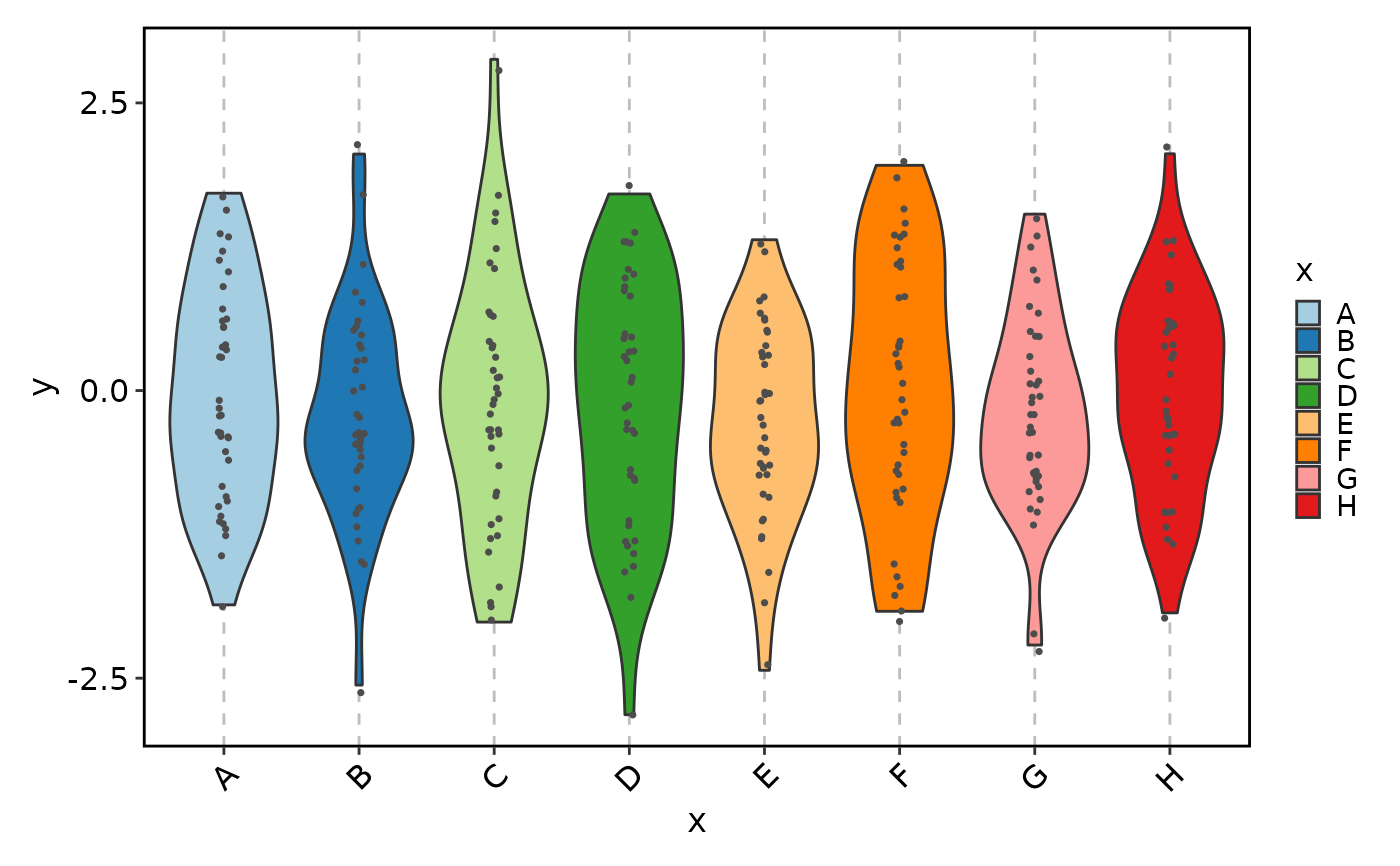
 ViolinPlot(data, x = "x", y = "y", add_beeswarm = TRUE, pt_color = "grey30")
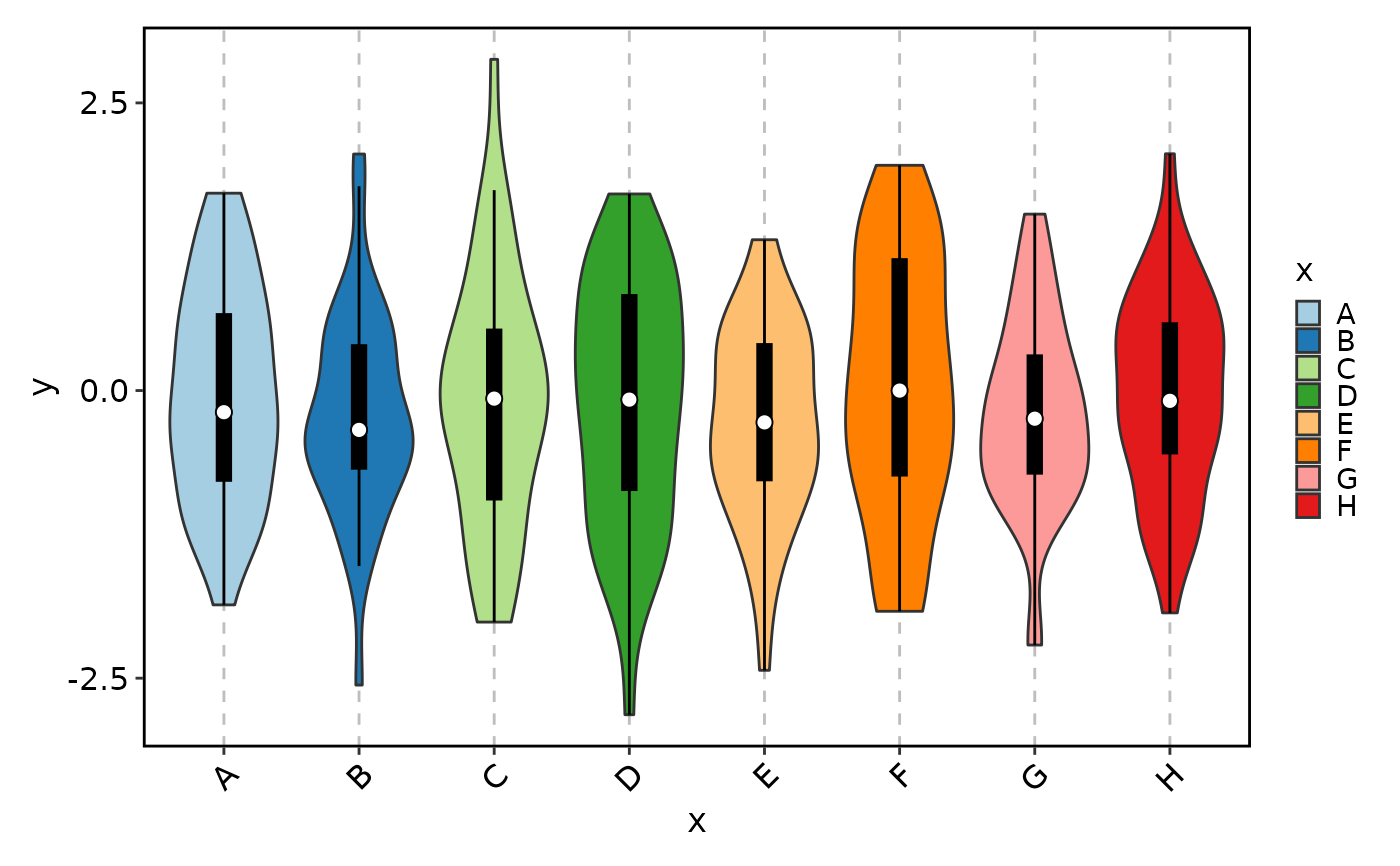
 ViolinPlot(data, x = "x", y = "y", add_box = TRUE)
 ViolinPlot(data, x = "x", y = "y", add_point = TRUE)
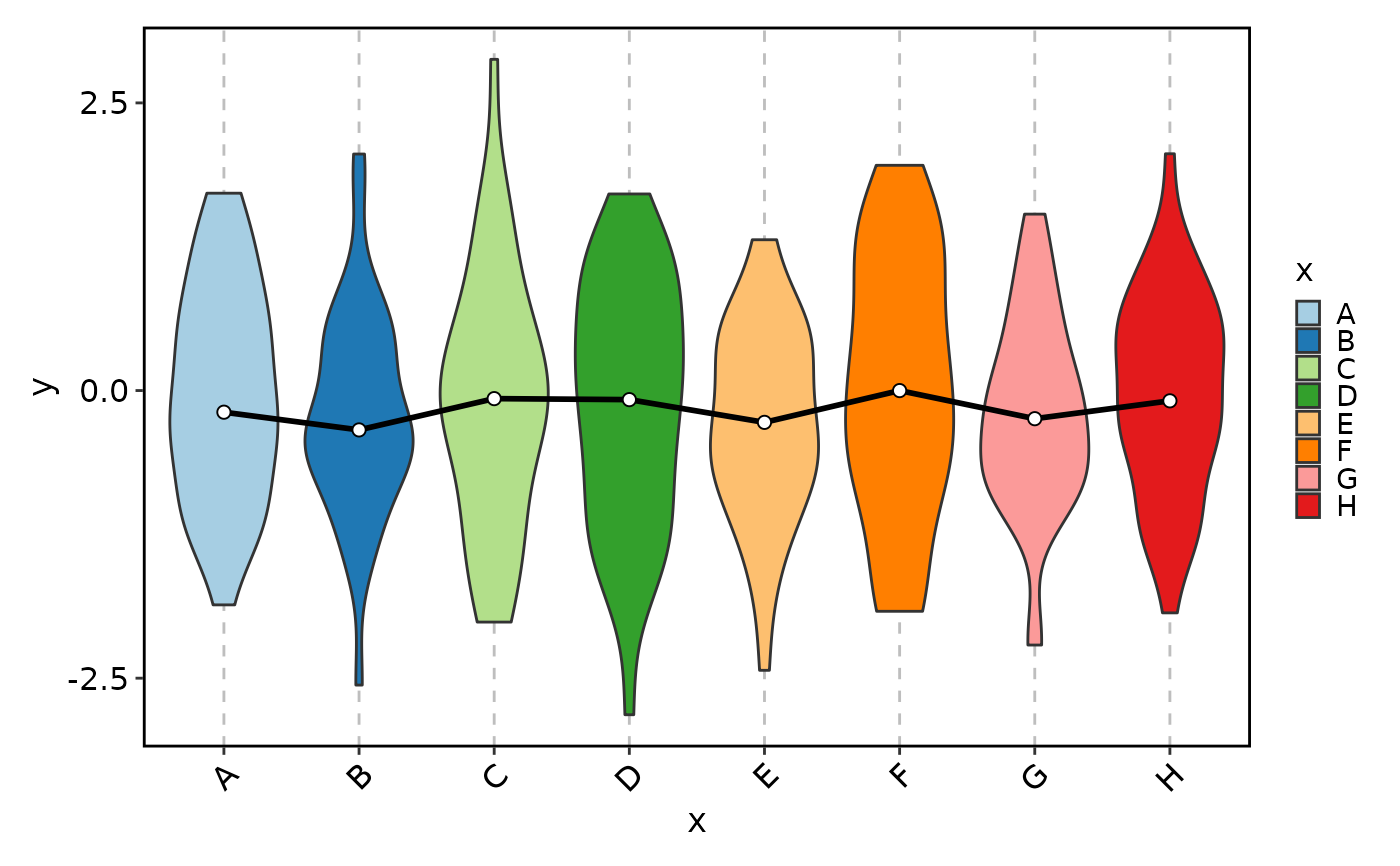
 ViolinPlot(data, x = "x", y = "y", add_trend = TRUE)
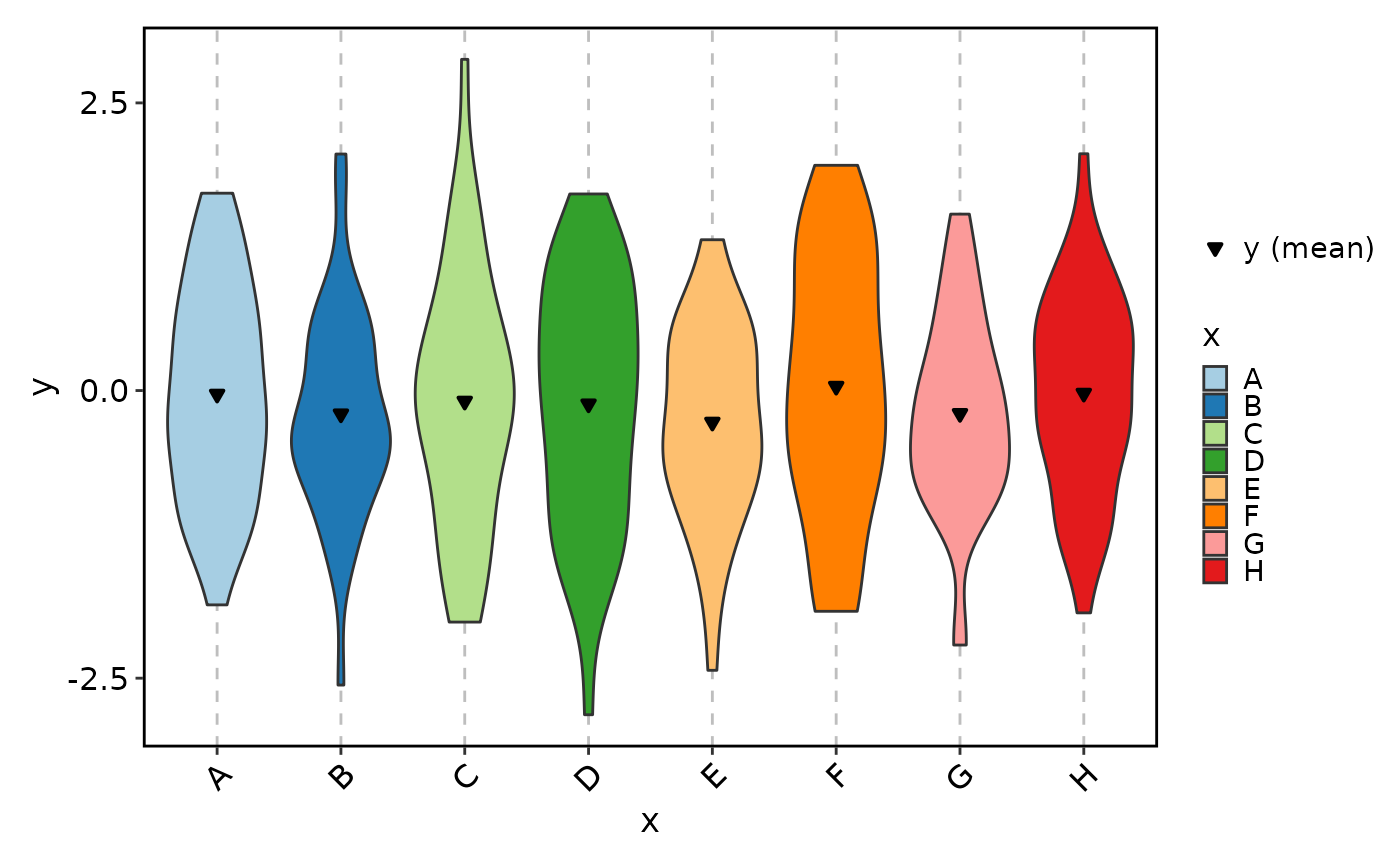
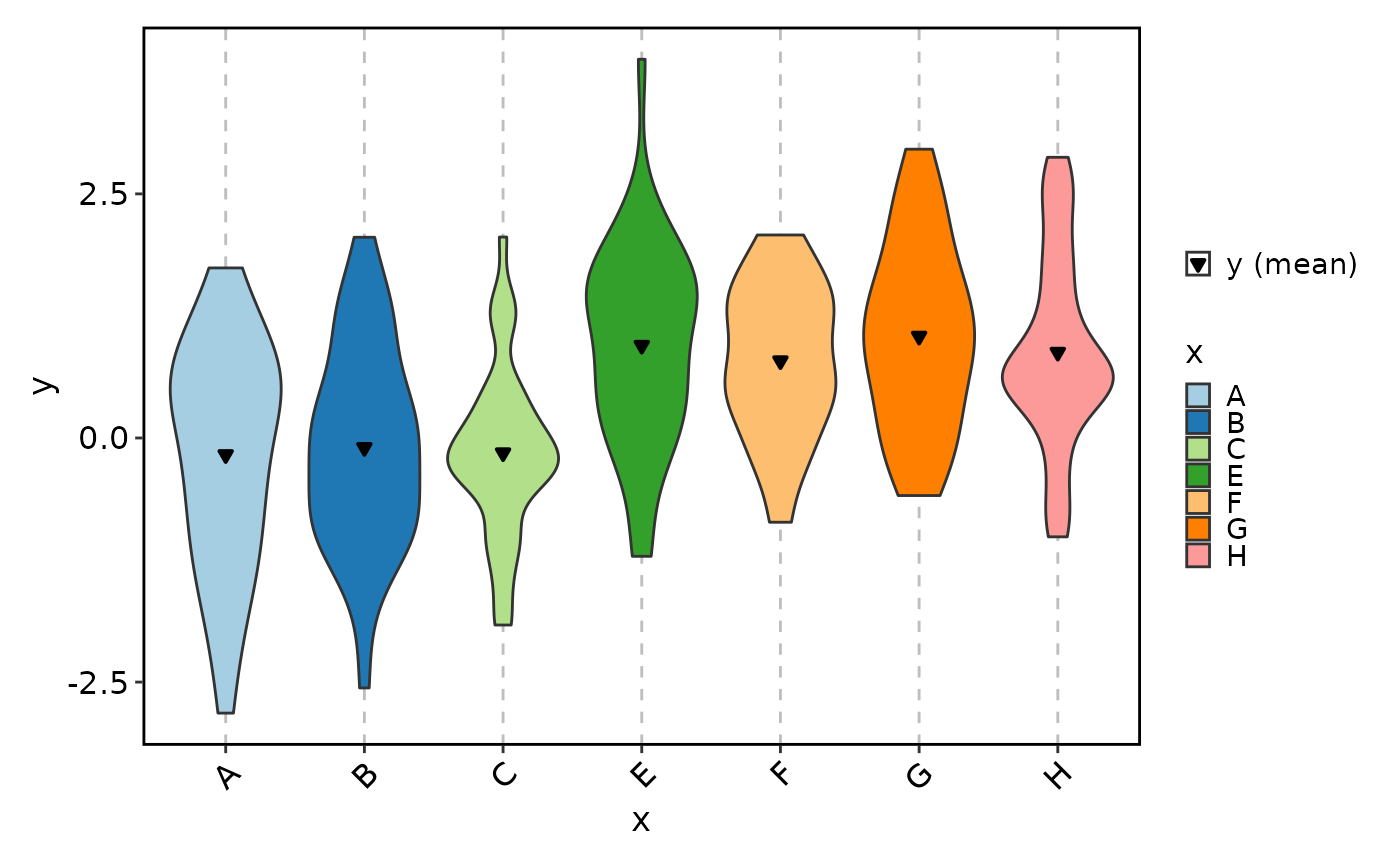
 ViolinPlot(data, x = "x", y = "y", add_stat = mean)
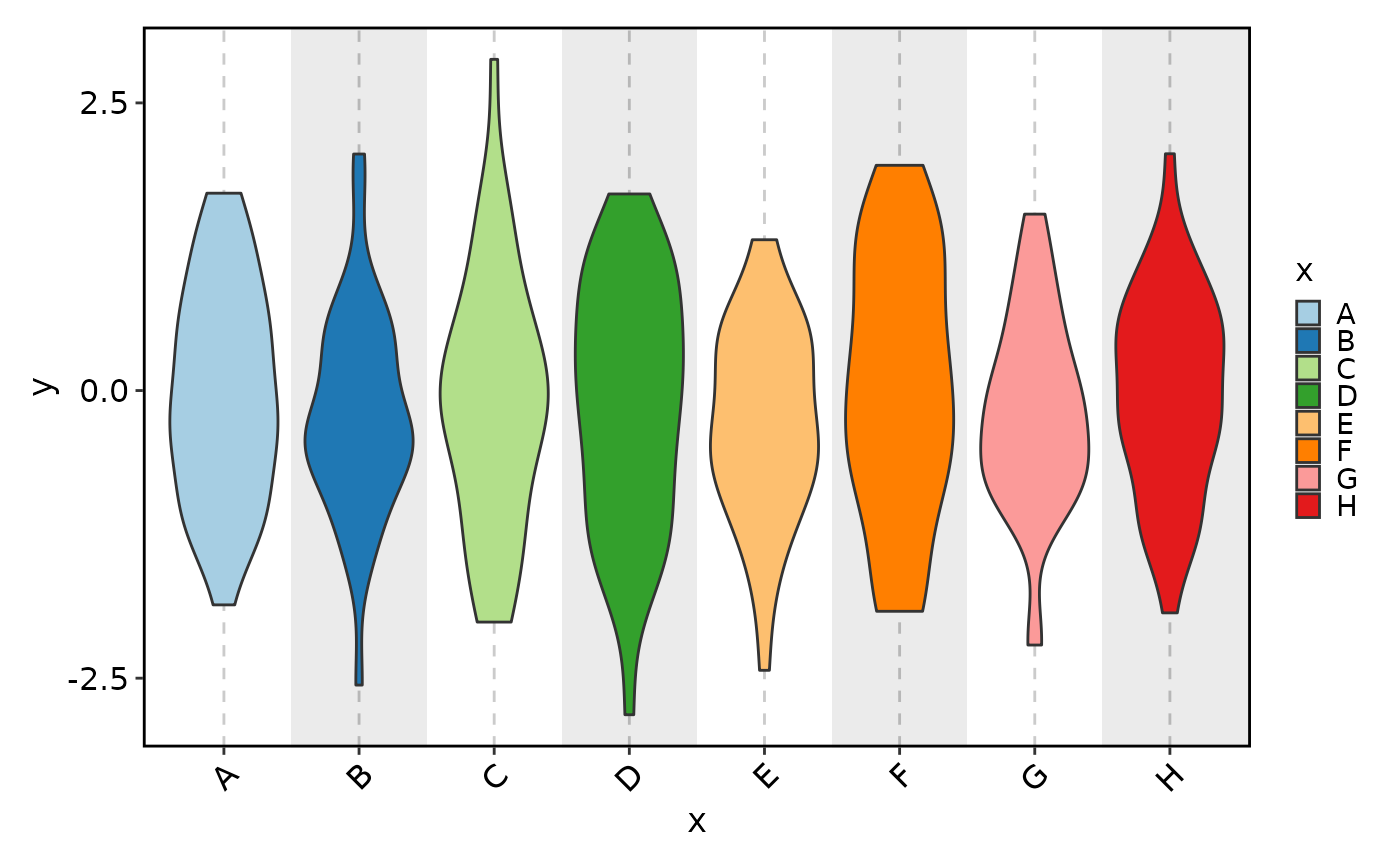
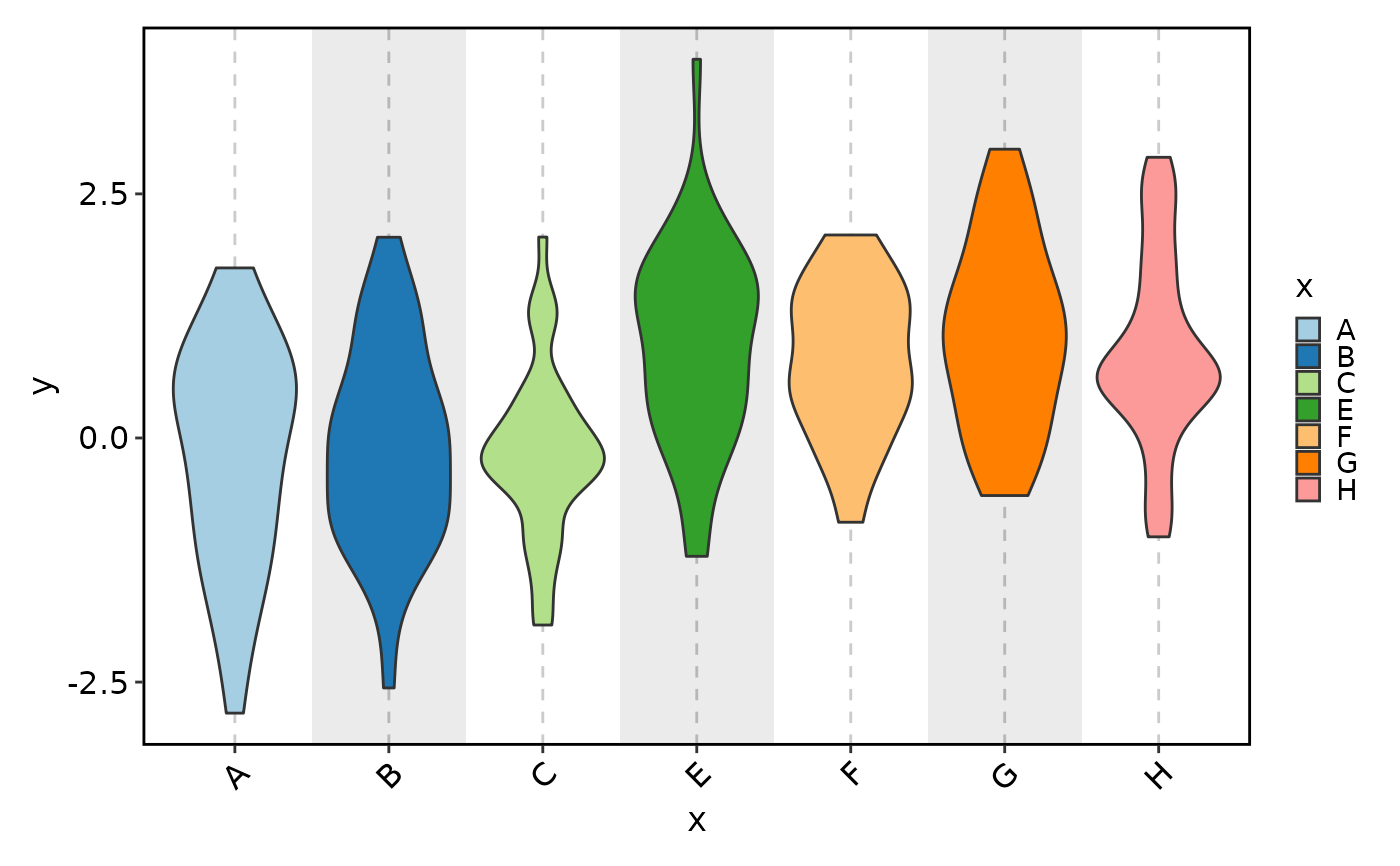
 ViolinPlot(data, x = "x", y = "y", add_bg = TRUE)
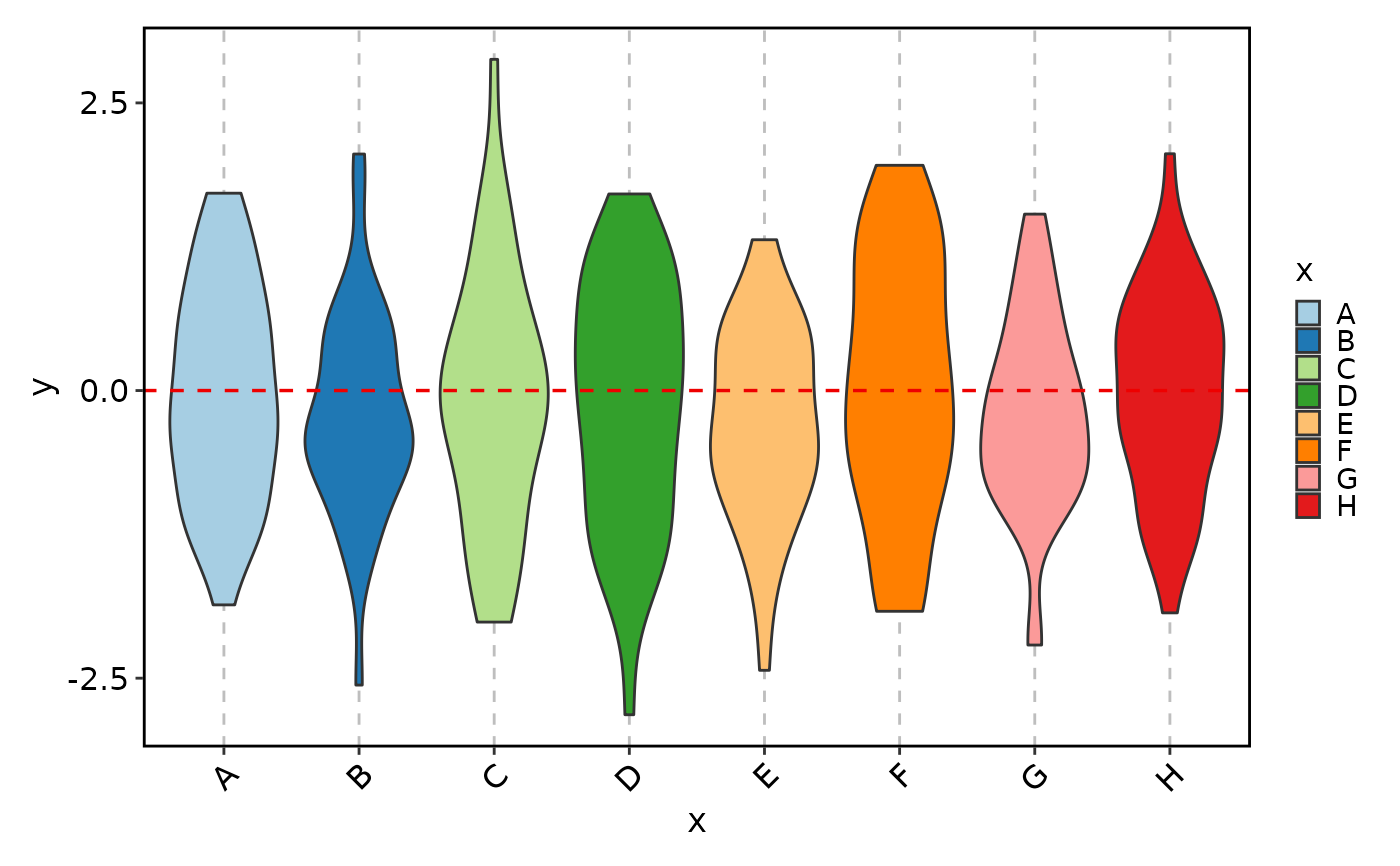
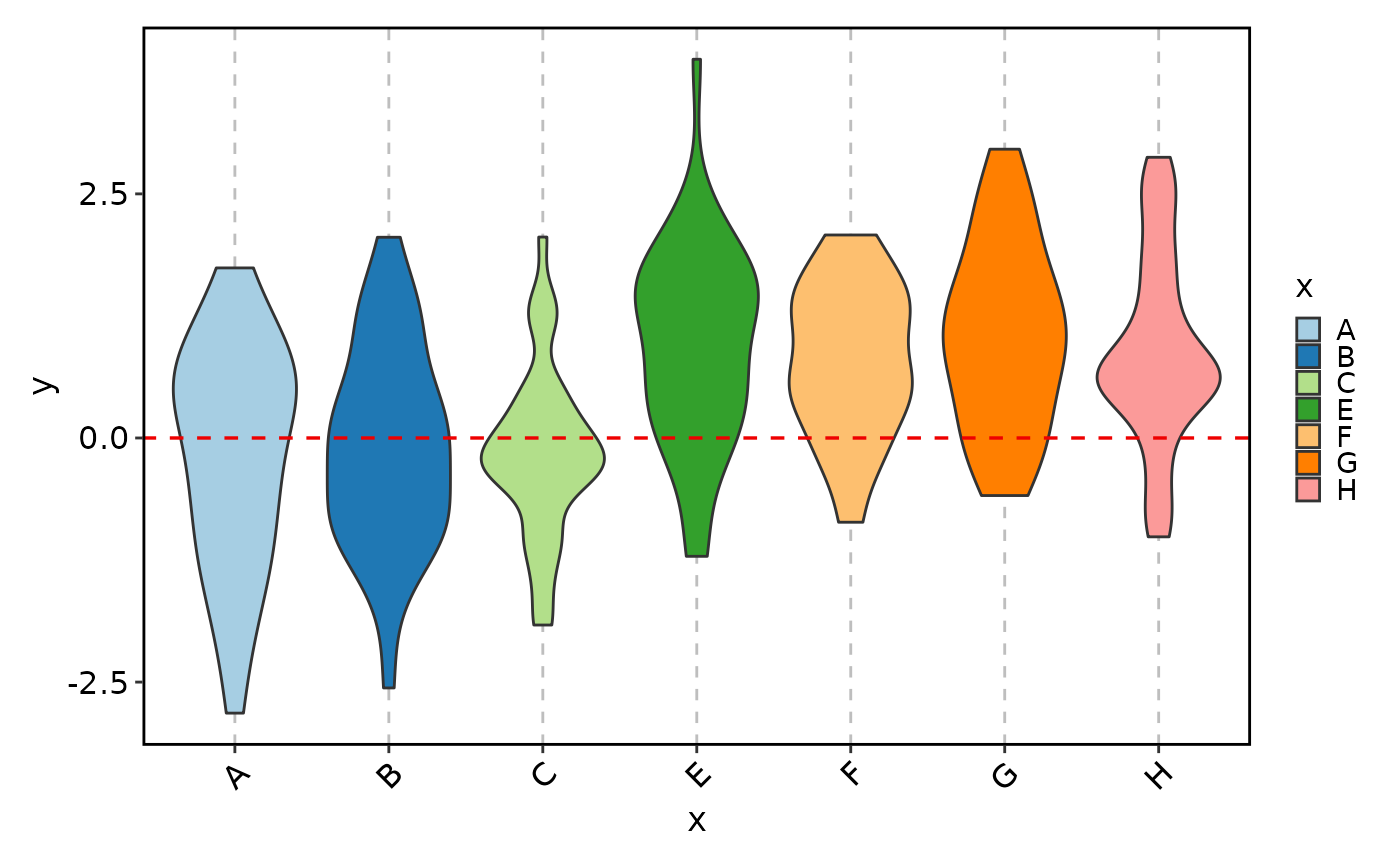
 ViolinPlot(data, x = "x", y = "y", add_line = 0)
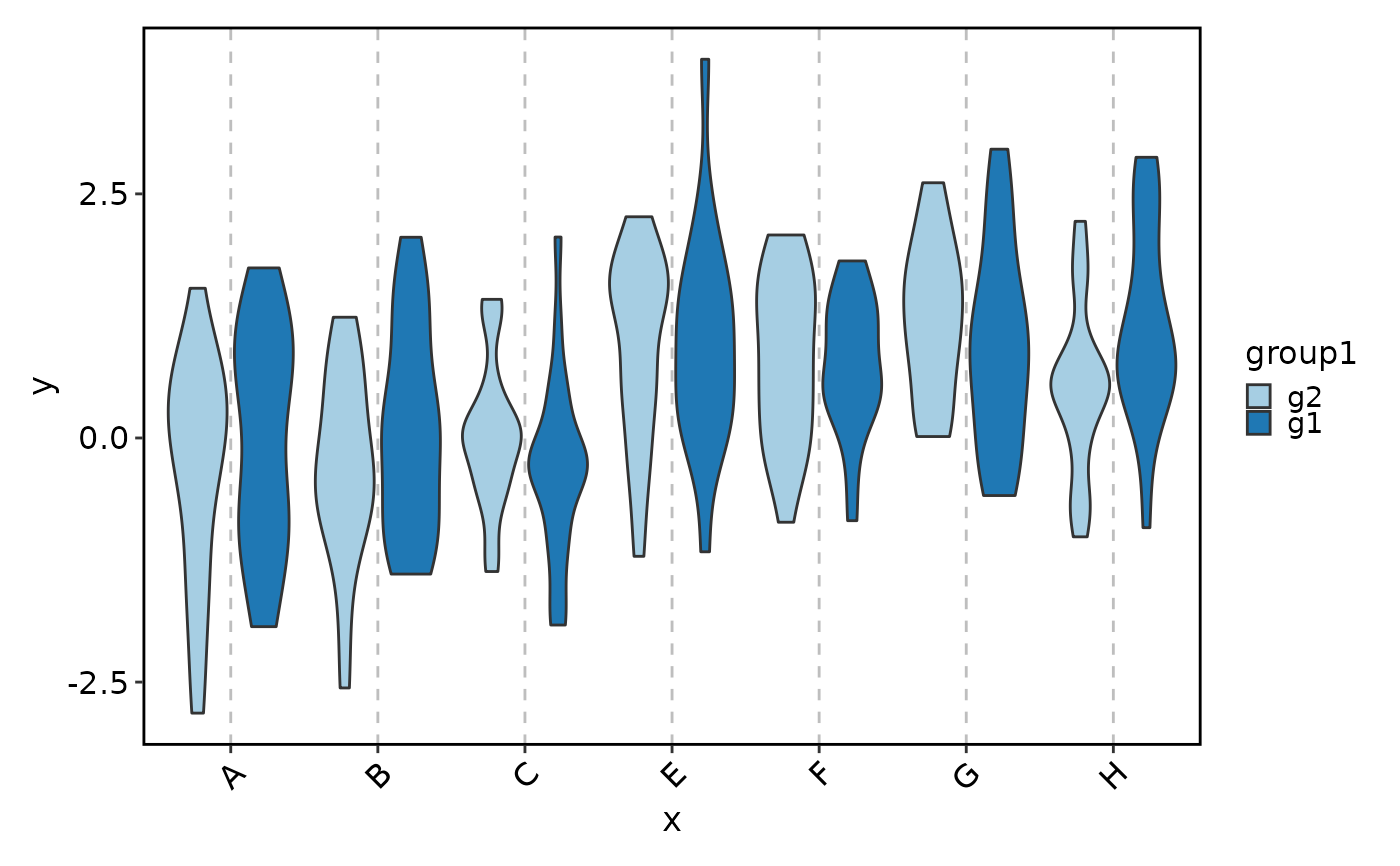
 # Grouped
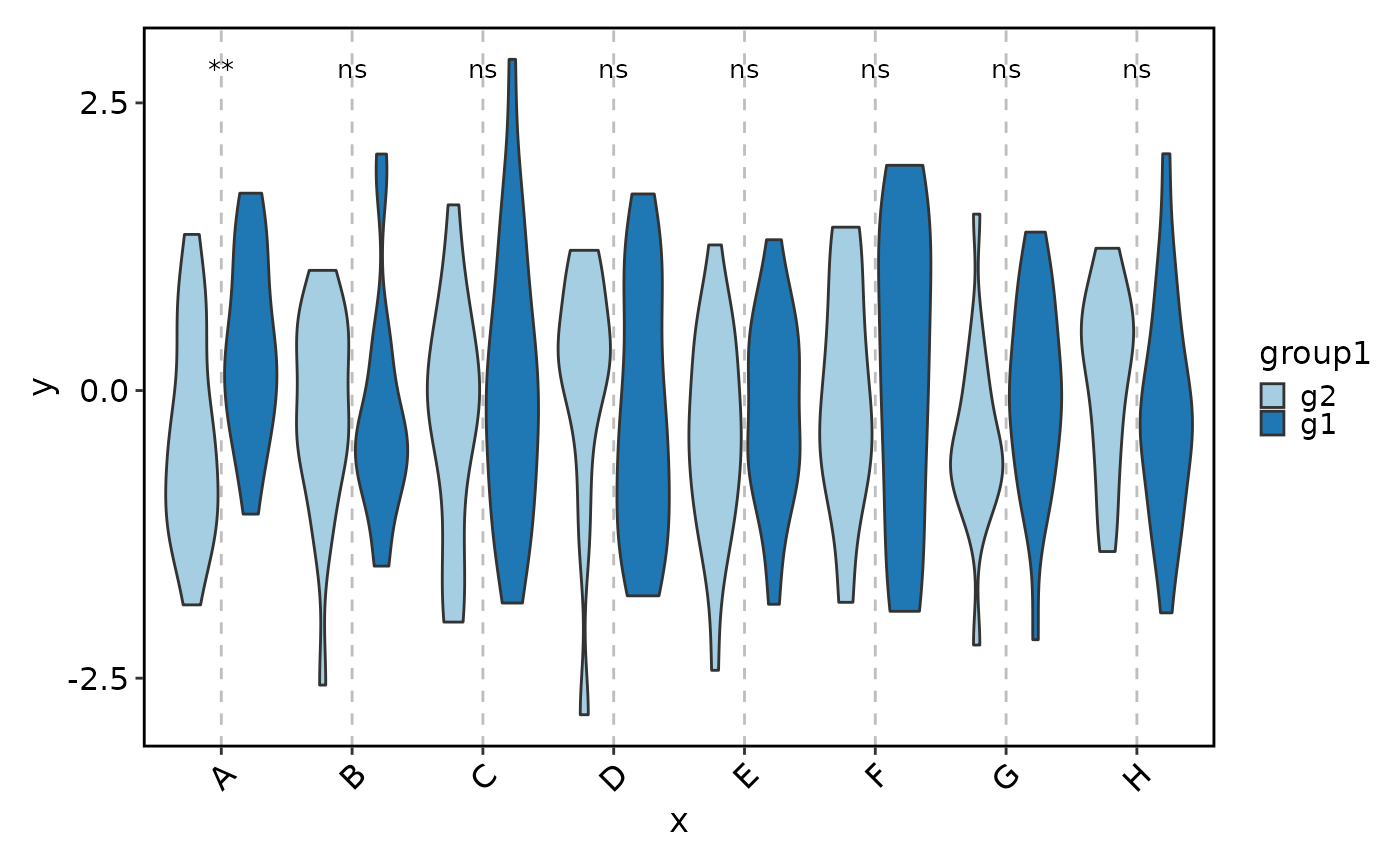
ViolinPlot(data, x = "x", y = "y", group_by = "group1")
# Grouped
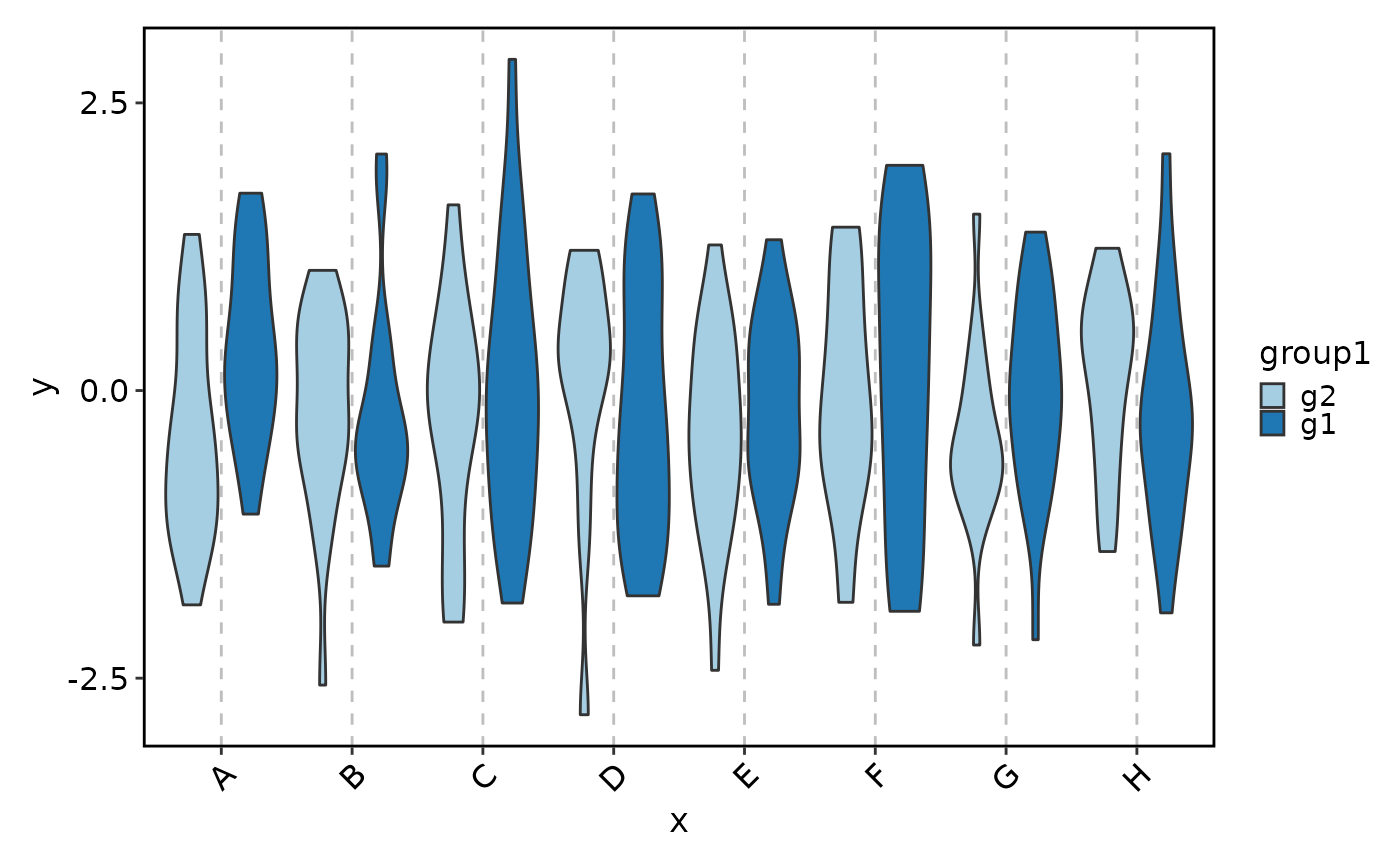
ViolinPlot(data, x = "x", y = "y", group_by = "group1")
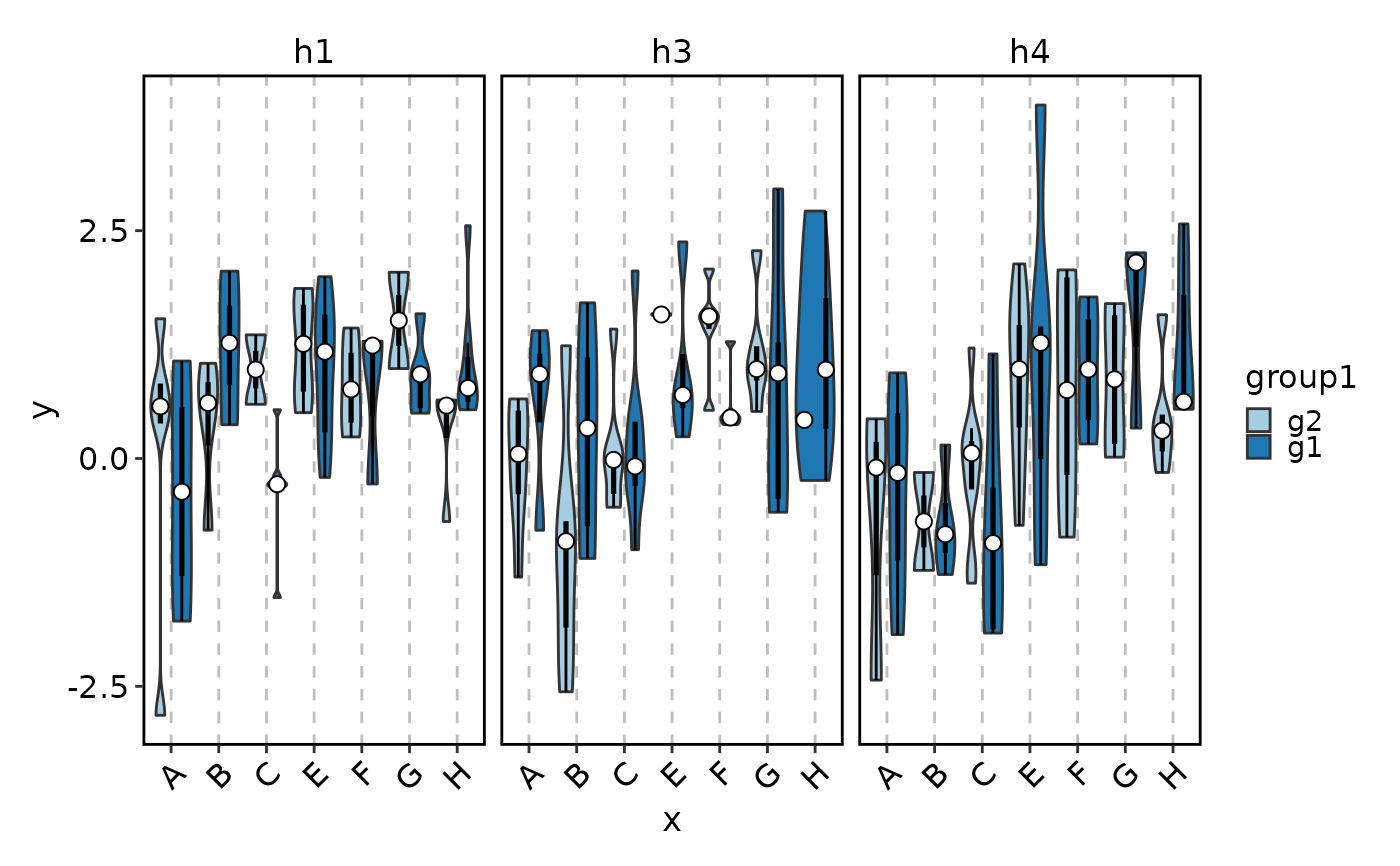
 # Grouped + faceted + box overlay
ViolinPlot(data,
x = "x", y = "y", group_by = "group1",
facet_by = "group2", add_box = TRUE)
#> Warning: Groups with fewer than two datapoints have been dropped.
#> ℹ Set `drop = FALSE` to consider such groups for position adjustment purposes.
#> Warning: Groups with fewer than two datapoints have been dropped.
#> ℹ Set `drop = FALSE` to consider such groups for position adjustment purposes.
# Grouped + faceted + box overlay
ViolinPlot(data,
x = "x", y = "y", group_by = "group1",
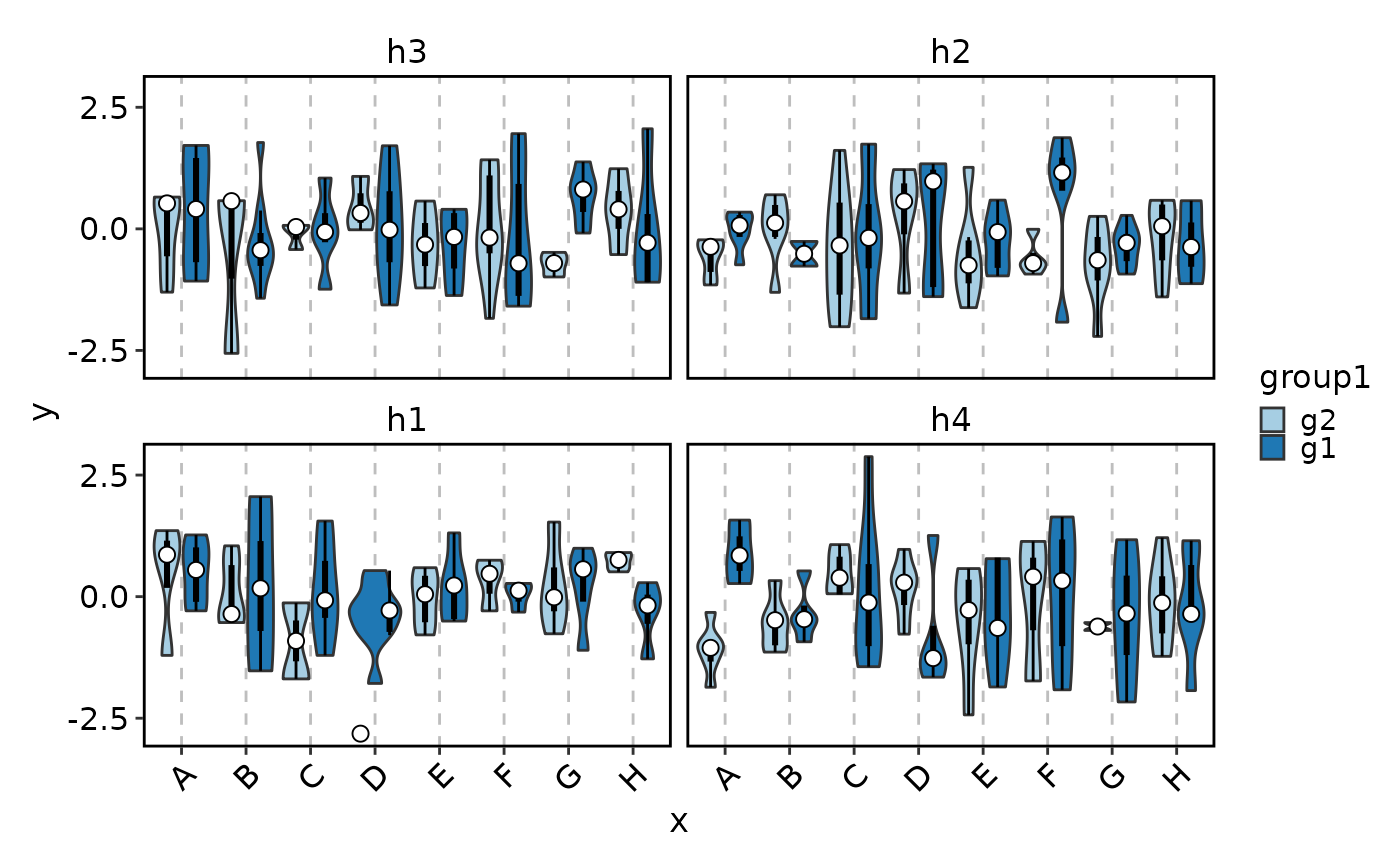
facet_by = "group2", add_box = TRUE)
#> Warning: Groups with fewer than two datapoints have been dropped.
#> ℹ Set `drop = FALSE` to consider such groups for position adjustment purposes.
#> Warning: Groups with fewer than two datapoints have been dropped.
#> ℹ Set `drop = FALSE` to consider such groups for position adjustment purposes.
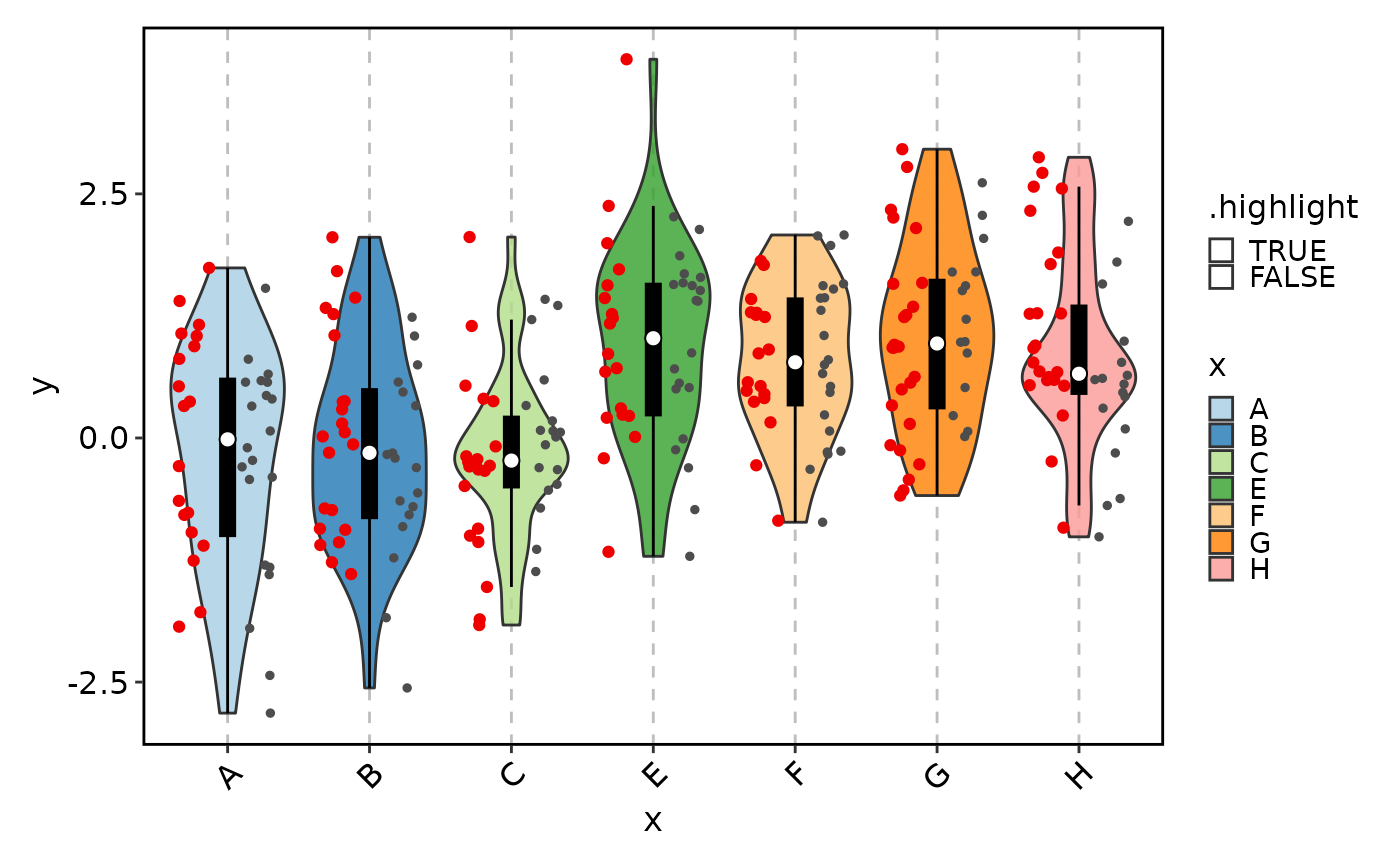
 # Highlight
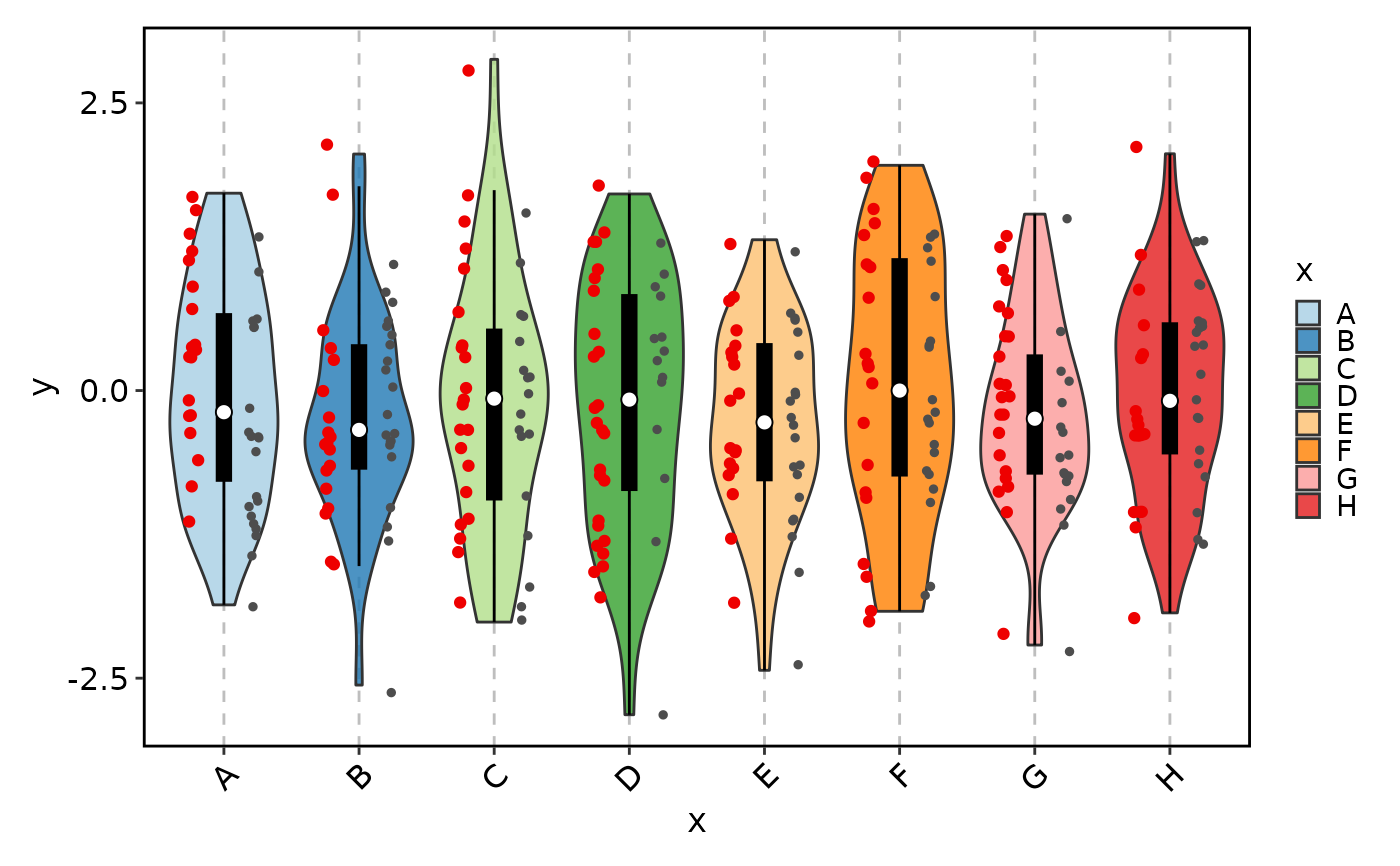
ViolinPlot(data,
x = "x", y = "y", add_point = TRUE,
highlight = 'group1 == "g1"', alpha = 0.8,
highlight_size = 1.5, pt_size = 1, add_box = TRUE)
# Highlight
ViolinPlot(data,
x = "x", y = "y", add_point = TRUE,
highlight = 'group1 == "g1"', alpha = 0.8,
highlight_size = 1.5, pt_size = 1, add_box = TRUE)
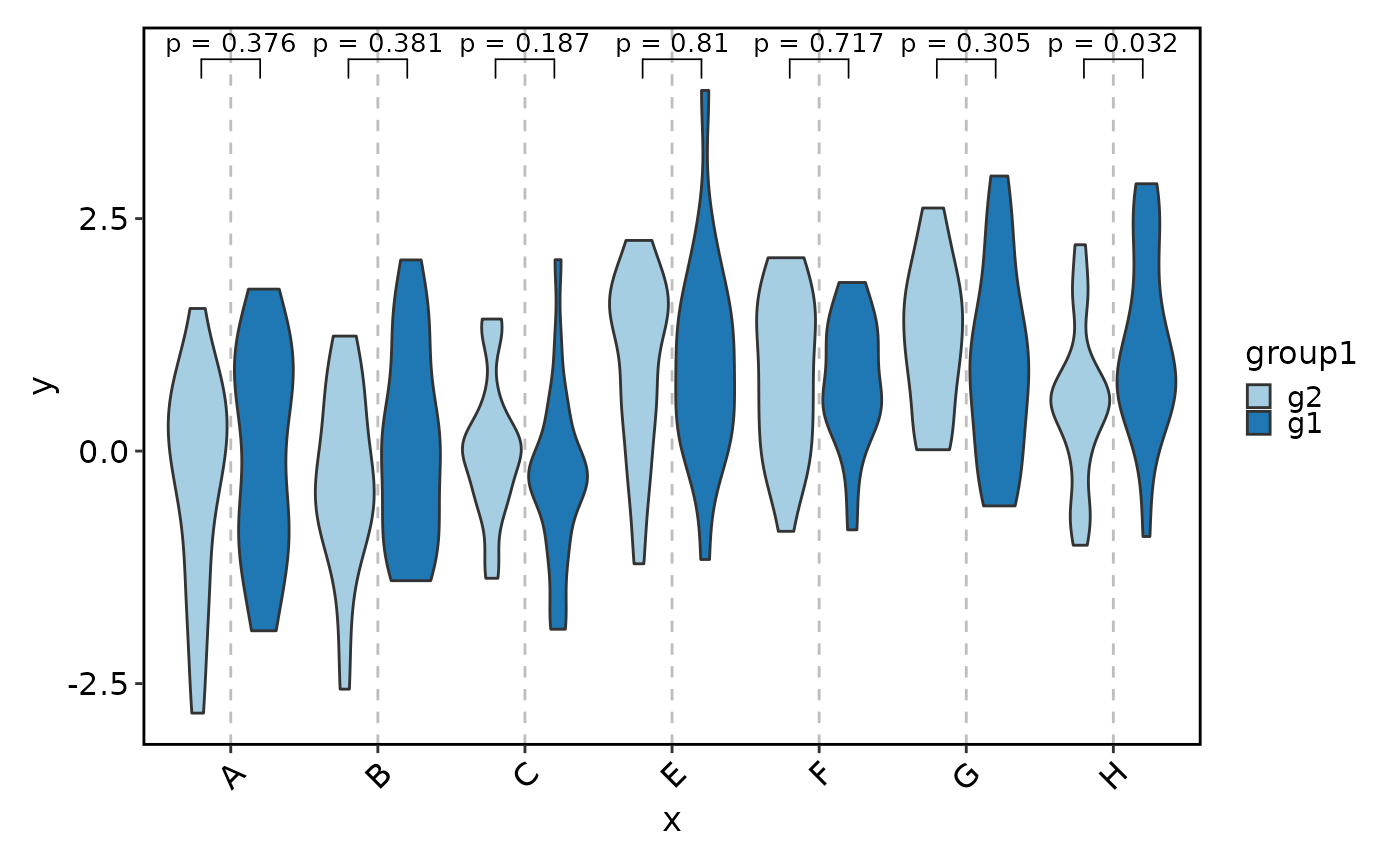
 # Pairwise comparisons with formatted labels
if (requireNamespace("ggpubr", quietly = TRUE)) {
# https://github.com/kassambara/ggpubr/issues/751
library(ggpubr)
ViolinPlot(data,
x = "x", y = "y", group_by = "group1",
comparisons = TRUE, sig_label = "p = {p}")
}
#> Loading required package: ggplot2
# Pairwise comparisons with formatted labels
if (requireNamespace("ggpubr", quietly = TRUE)) {
# https://github.com/kassambara/ggpubr/issues/751
library(ggpubr)
ViolinPlot(data,
x = "x", y = "y", group_by = "group1",
comparisons = TRUE, sig_label = "p = {p}")
}
#> Loading required package: ggplot2
 # Explicit comparison list + hide non-significant
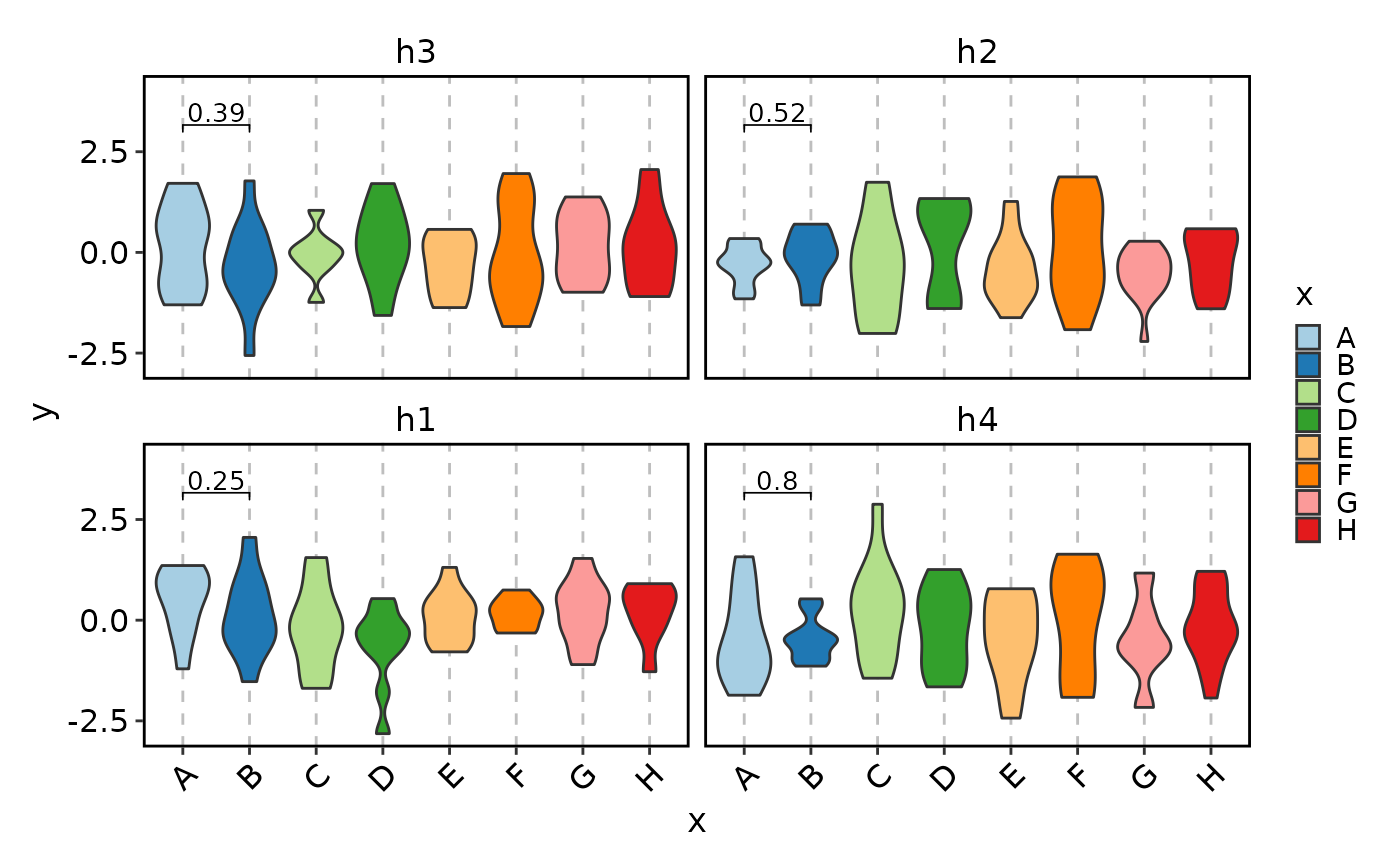
ViolinPlot(data,
x = "x", y = "y", sig_label = "p.format", hide_ns = TRUE,
facet_by = "group2", comparisons = list(c("D", "E")))
# Explicit comparison list + hide non-significant
ViolinPlot(data,
x = "x", y = "y", sig_label = "p.format", hide_ns = TRUE,
facet_by = "group2", comparisons = list(c("D", "E")))
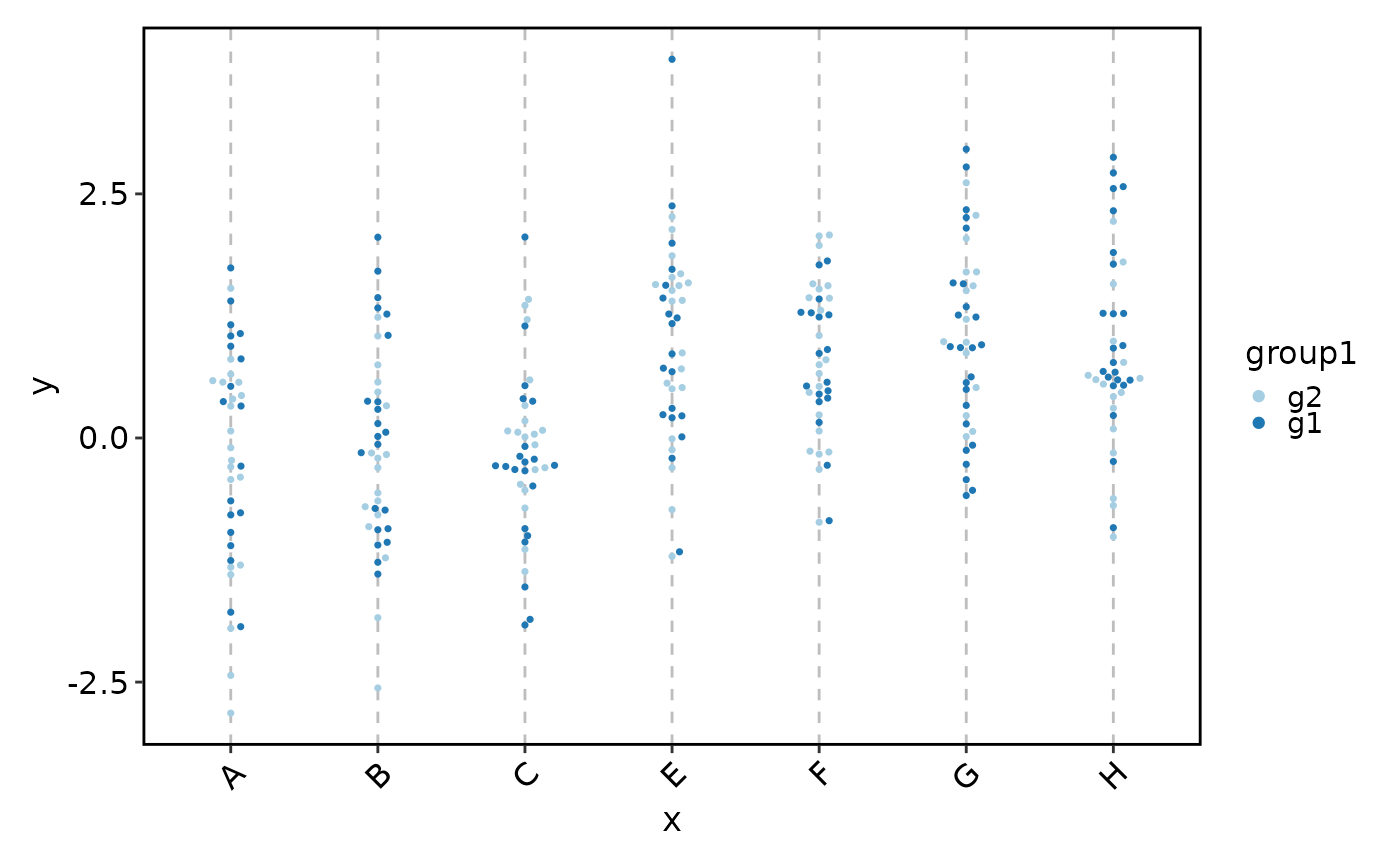 # Continuous fill (mean) + omnibus test
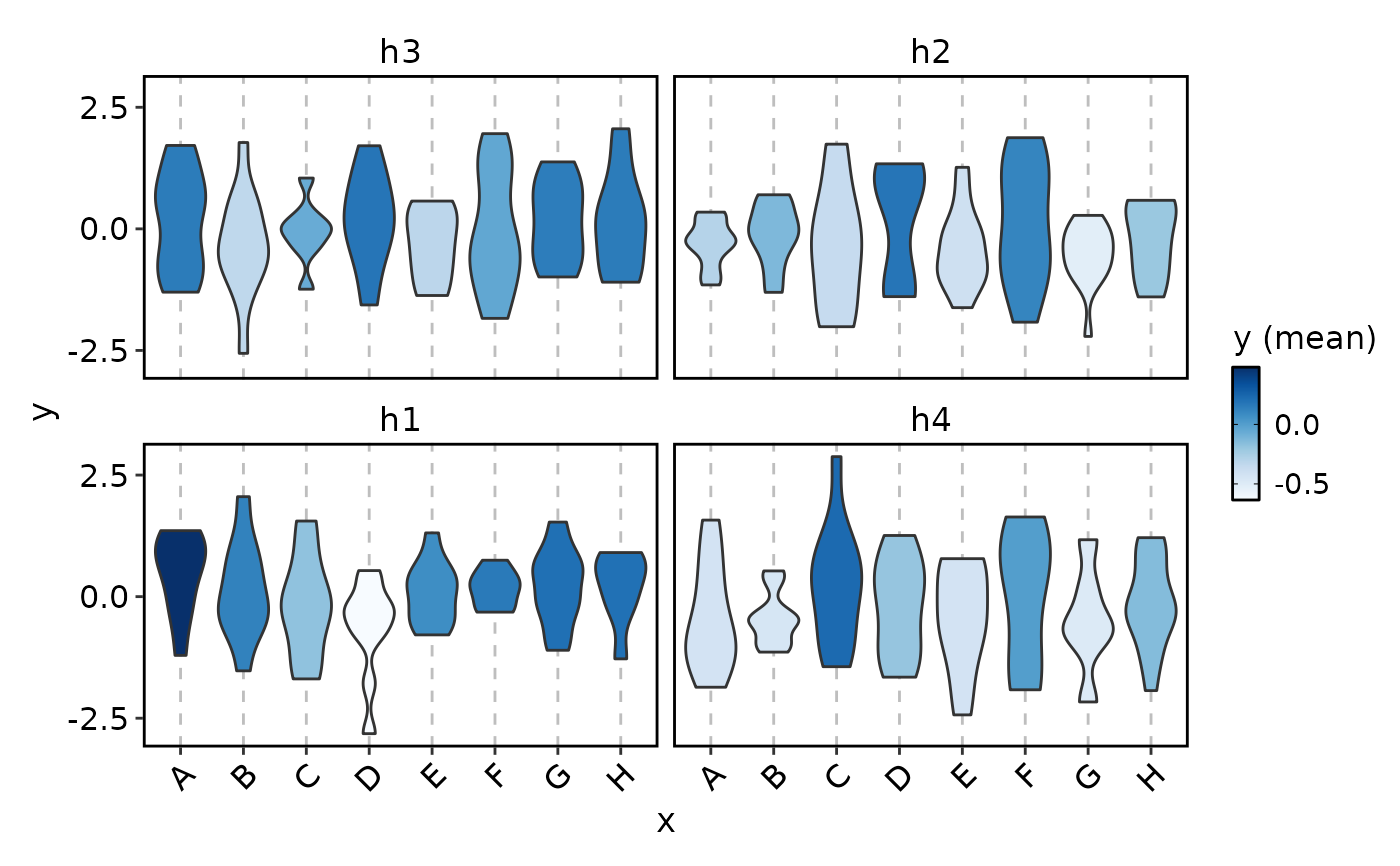
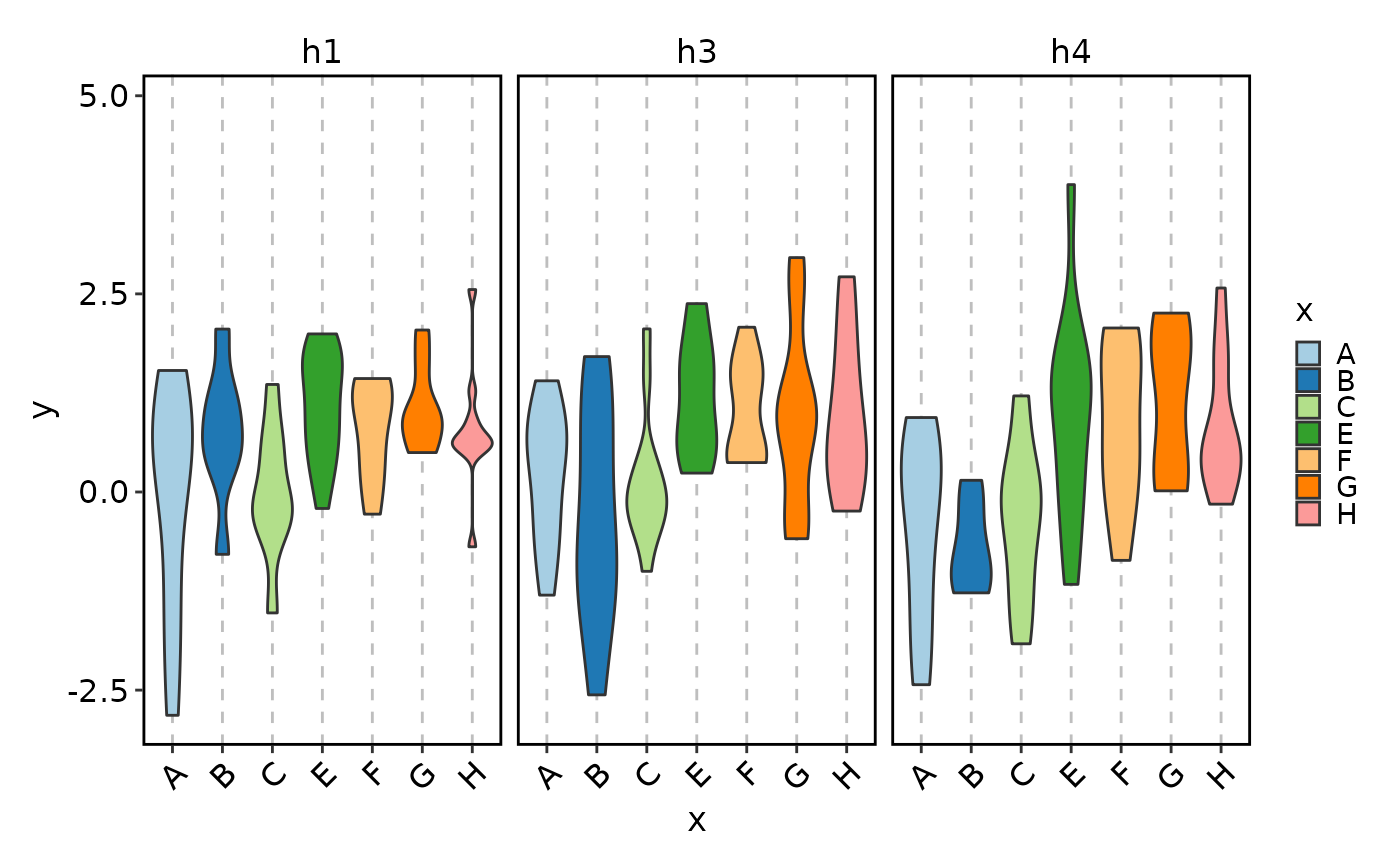
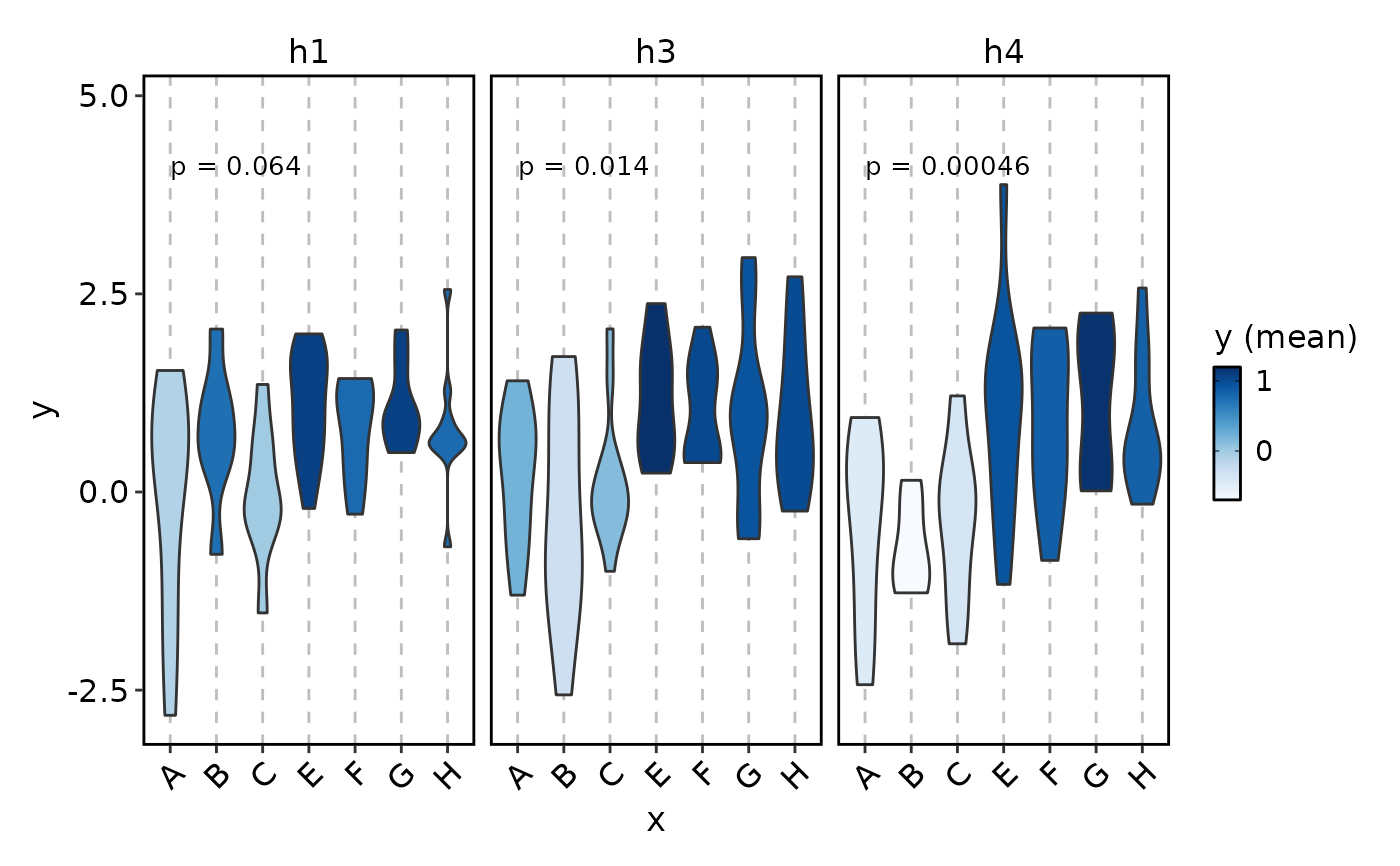
ViolinPlot(data,
x = "x", y = "y", fill_mode = "mean",
facet_by = "group2", palette = "Blues",
multiplegroup_comparisons = TRUE)
#> Warning: The following aesthetics were dropped during statistical transformation: fill.
#> ℹ This can happen when ggplot fails to infer the correct grouping structure in
#> the data.
#> ℹ Did you forget to specify a `group` aesthetic or to convert a numerical
#> variable into a factor?
#> Warning: The following aesthetics were dropped during statistical transformation: fill.
#> ℹ This can happen when ggplot fails to infer the correct grouping structure in
#> the data.
#> ℹ Did you forget to specify a `group` aesthetic or to convert a numerical
#> variable into a factor?
#> Warning: The following aesthetics were dropped during statistical transformation: fill.
#> ℹ This can happen when ggplot fails to infer the correct grouping structure in
#> the data.
#> ℹ Did you forget to specify a `group` aesthetic or to convert a numerical
#> variable into a factor?
# Continuous fill (mean) + omnibus test
ViolinPlot(data,
x = "x", y = "y", fill_mode = "mean",
facet_by = "group2", palette = "Blues",
multiplegroup_comparisons = TRUE)
#> Warning: The following aesthetics were dropped during statistical transformation: fill.
#> ℹ This can happen when ggplot fails to infer the correct grouping structure in
#> the data.
#> ℹ Did you forget to specify a `group` aesthetic or to convert a numerical
#> variable into a factor?
#> Warning: The following aesthetics were dropped during statistical transformation: fill.
#> ℹ This can happen when ggplot fails to infer the correct grouping structure in
#> the data.
#> ℹ Did you forget to specify a `group` aesthetic or to convert a numerical
#> variable into a factor?
#> Warning: The following aesthetics were dropped during statistical transformation: fill.
#> ℹ This can happen when ggplot fails to infer the correct grouping structure in
#> the data.
#> ℹ Did you forget to specify a `group` aesthetic or to convert a numerical
#> variable into a factor?
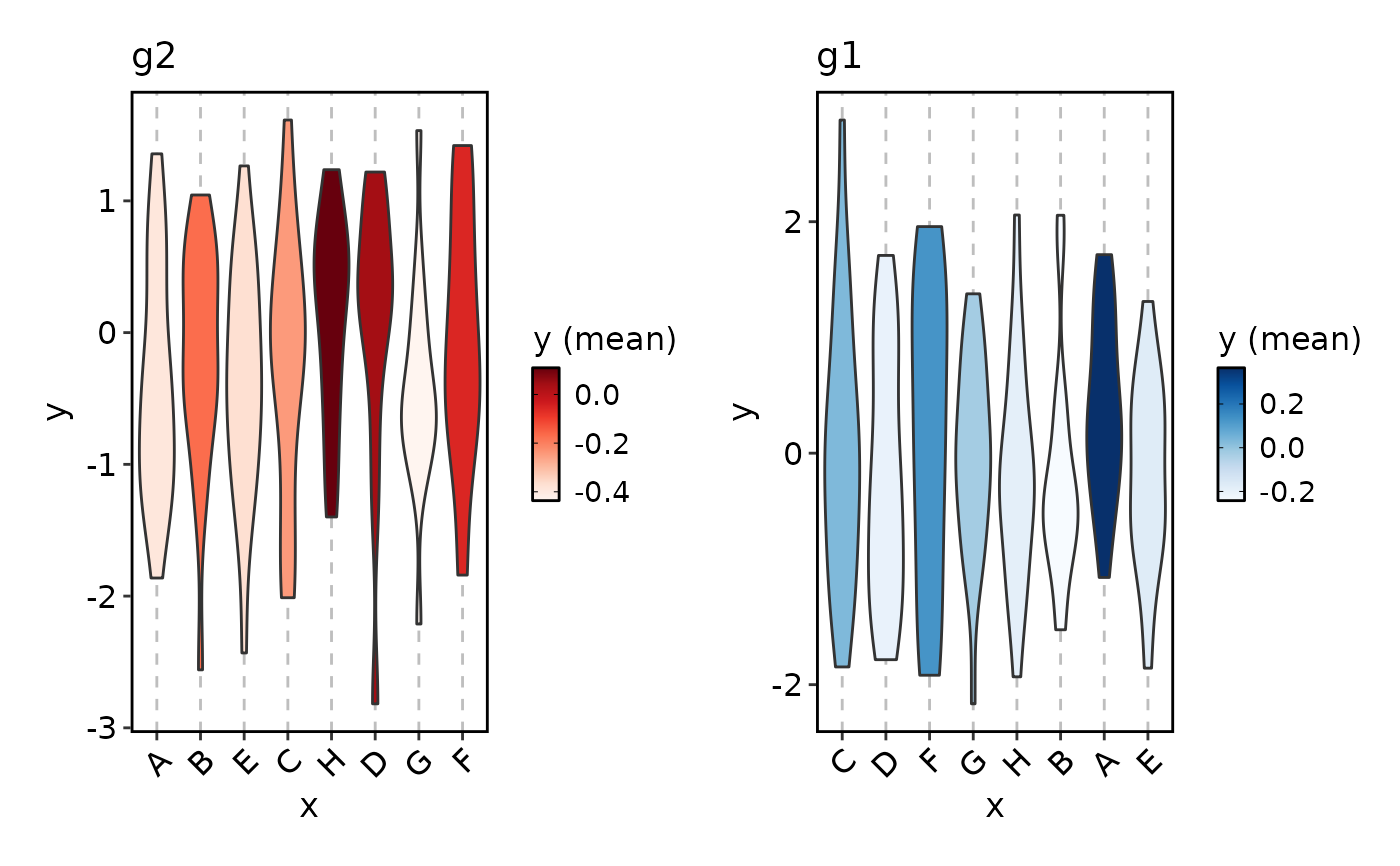
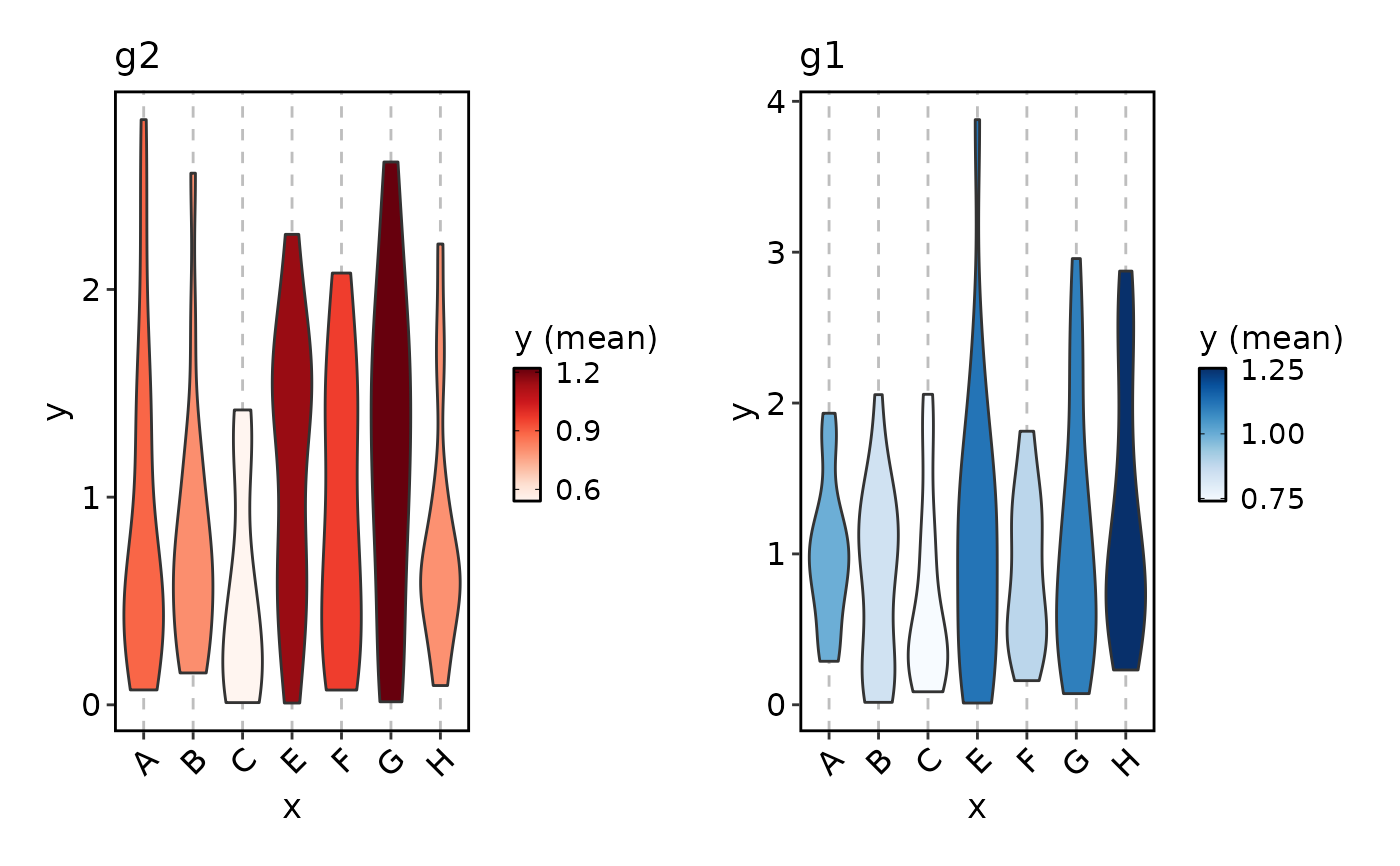
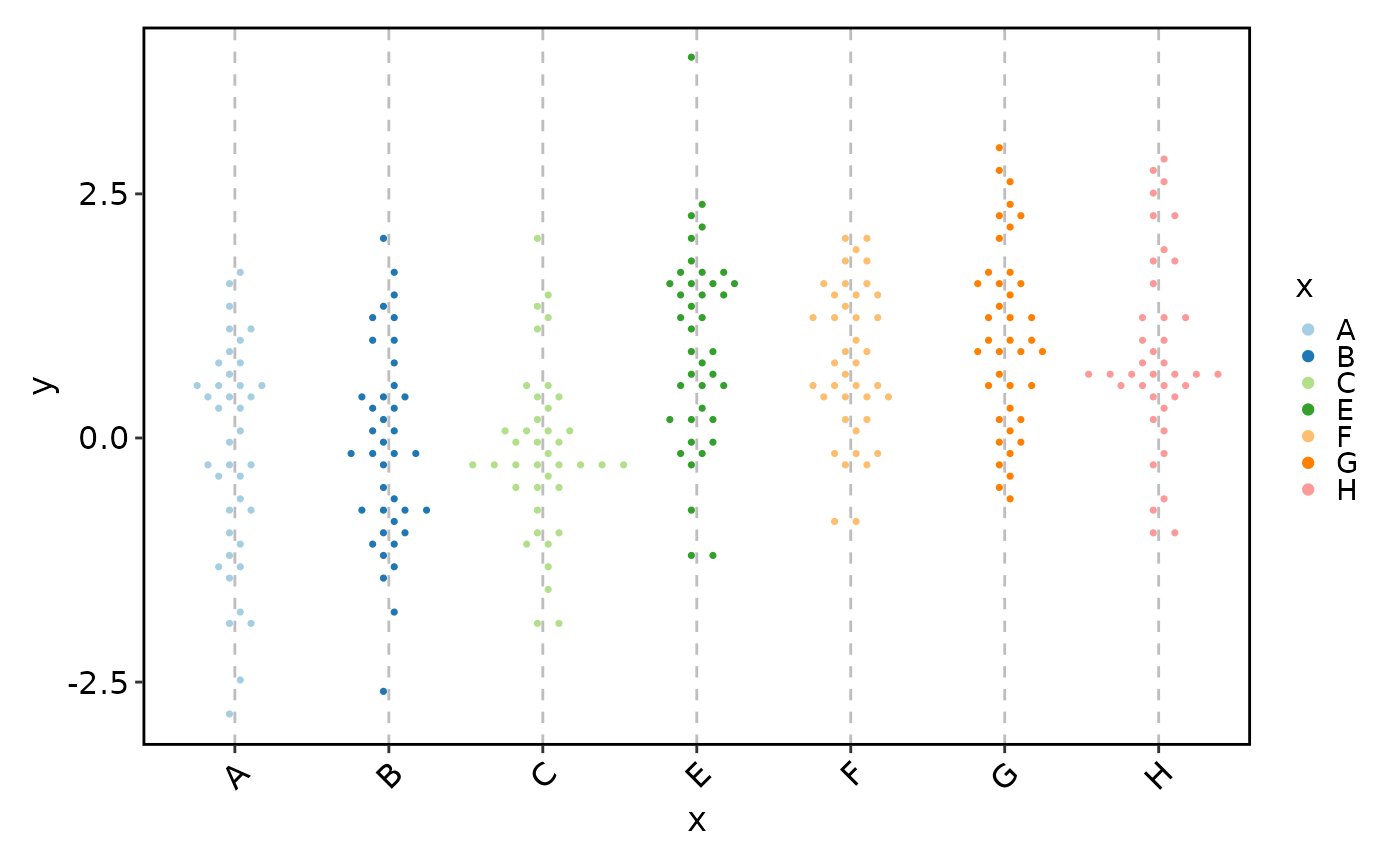 # Per-split palettes
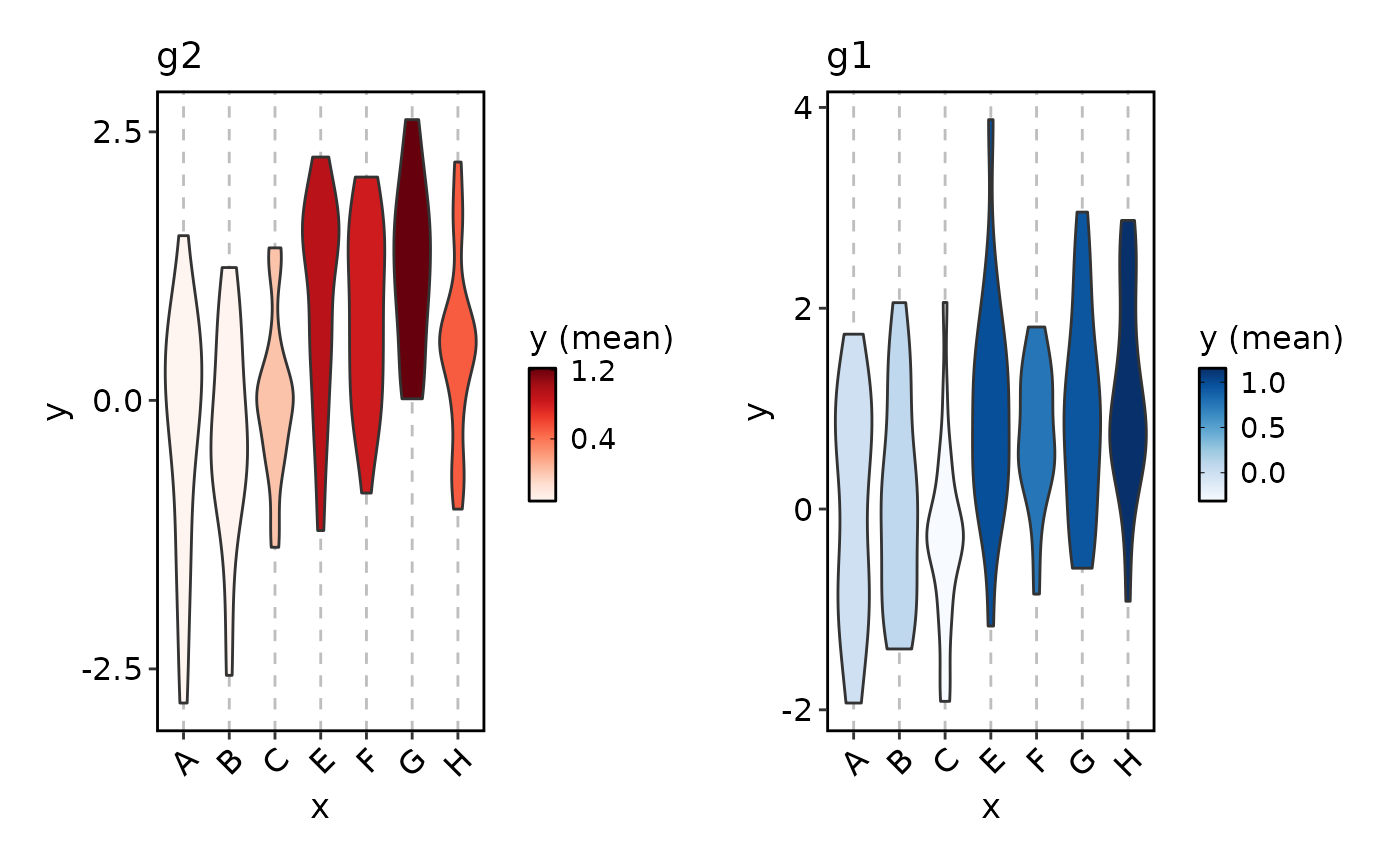
ViolinPlot(data,
x = "x", y = "y", fill_mode = "mean",
split_by = "group1", palette = c(g1 = "Blues", g2 = "Reds"))
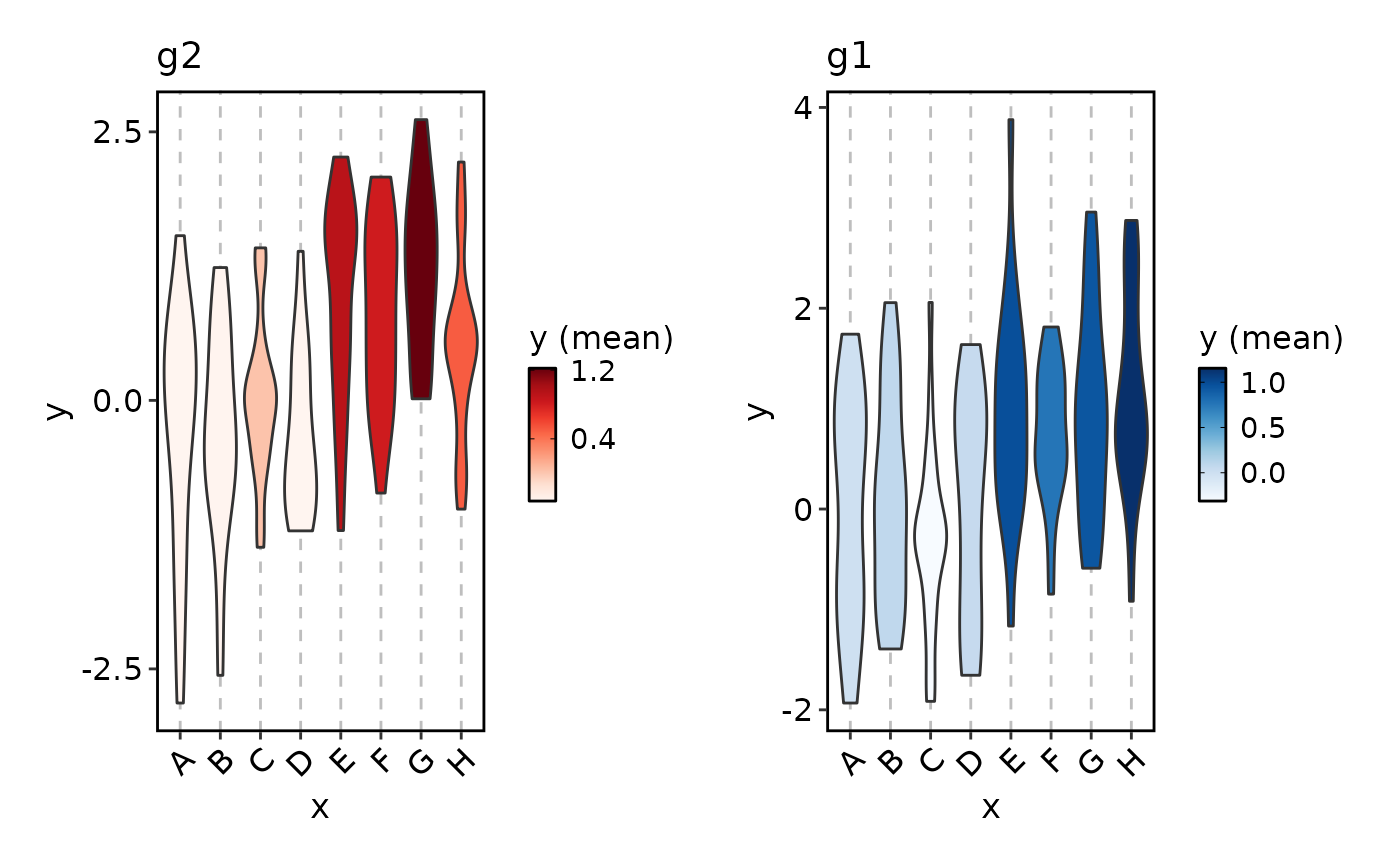
# Per-split palettes
ViolinPlot(data,
x = "x", y = "y", fill_mode = "mean",
split_by = "group1", palette = c(g1 = "Blues", g2 = "Reds"))
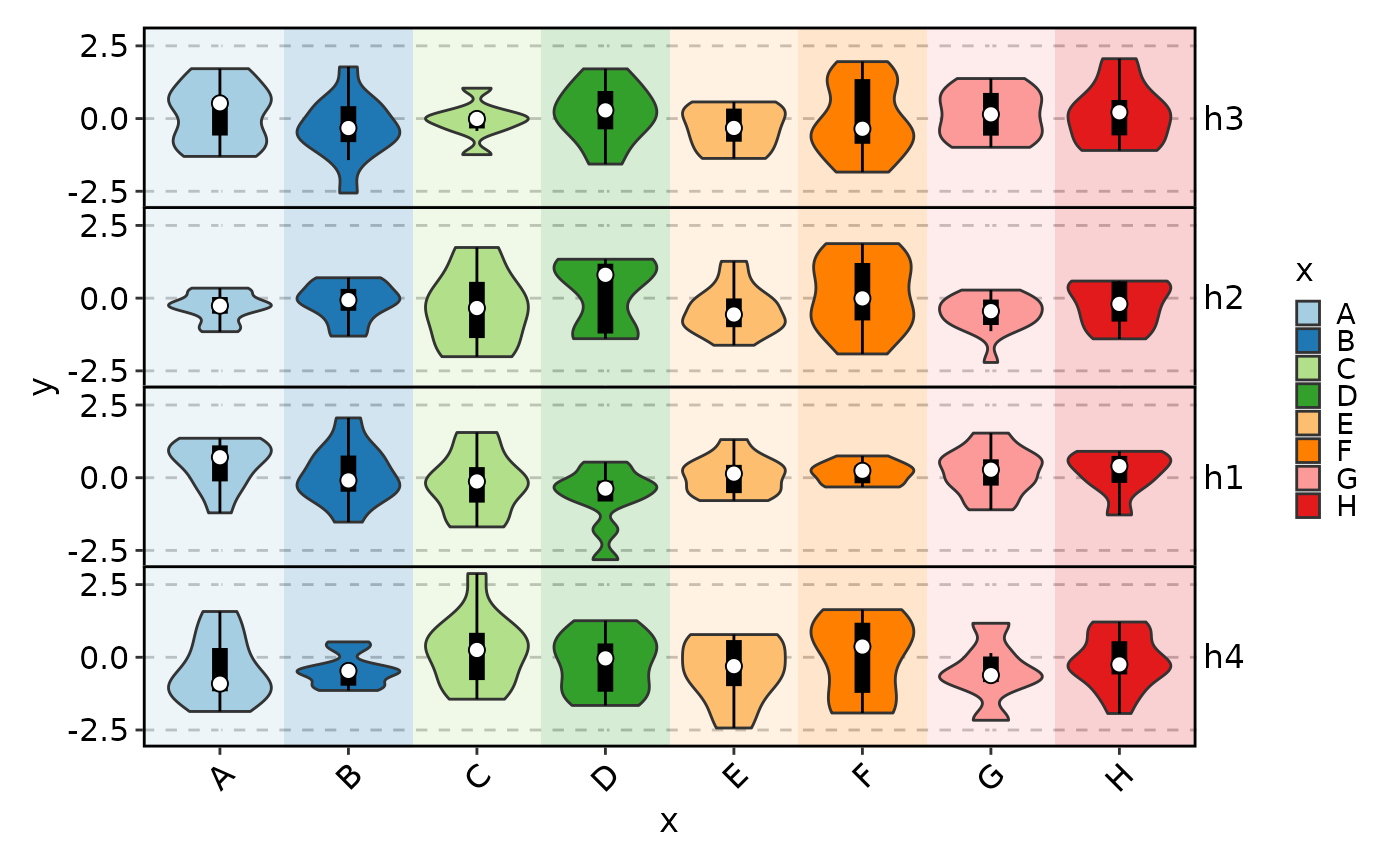
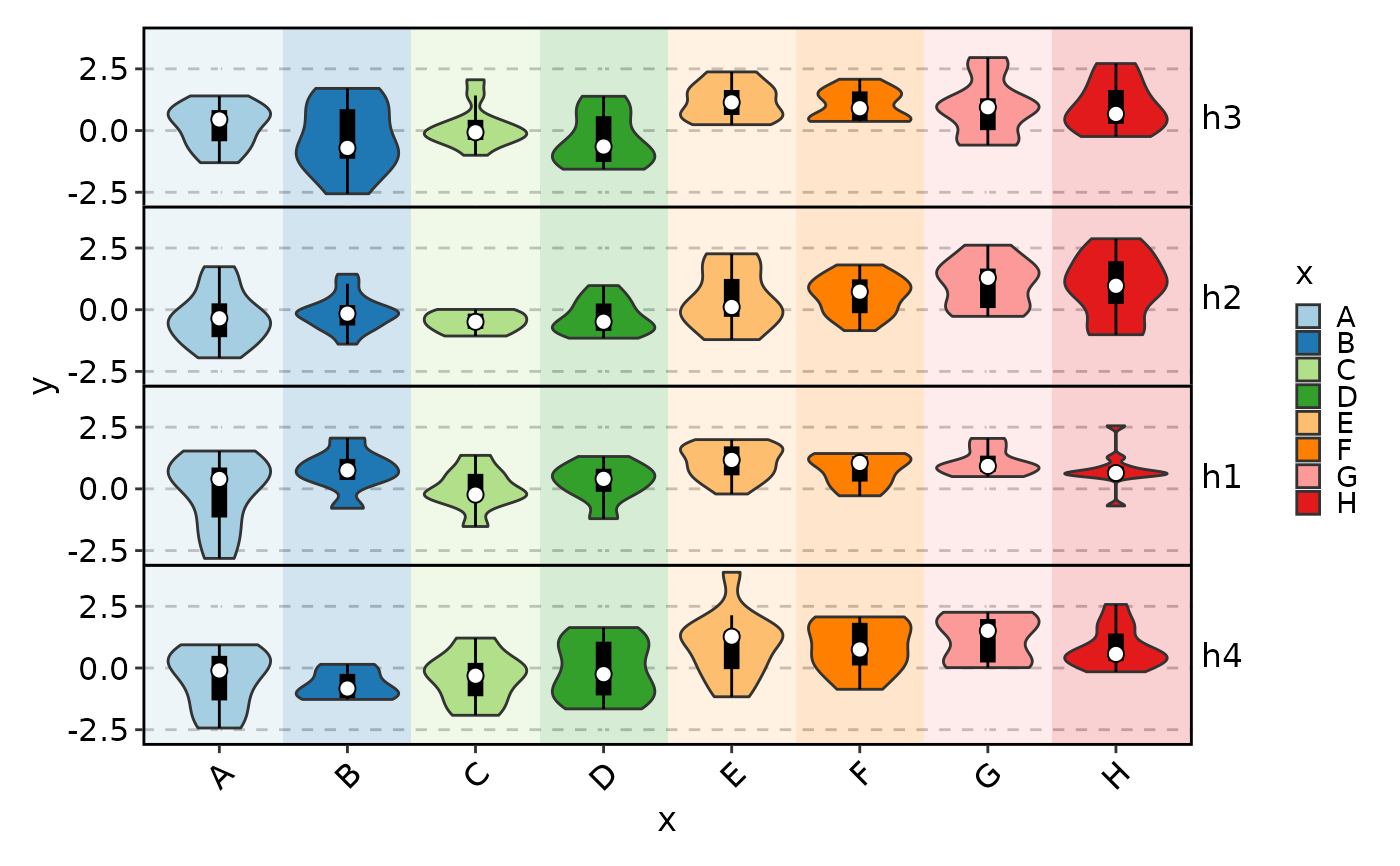
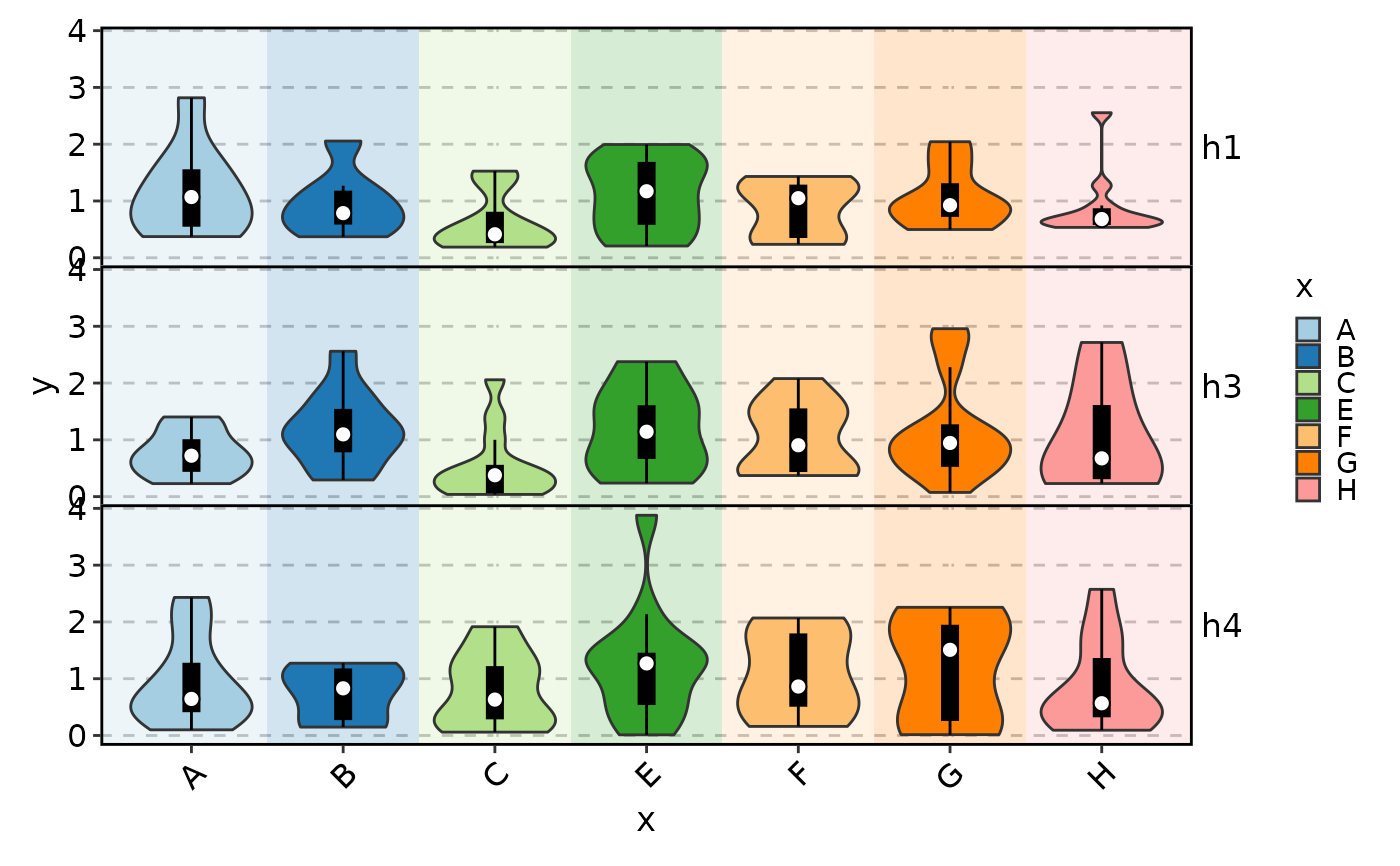
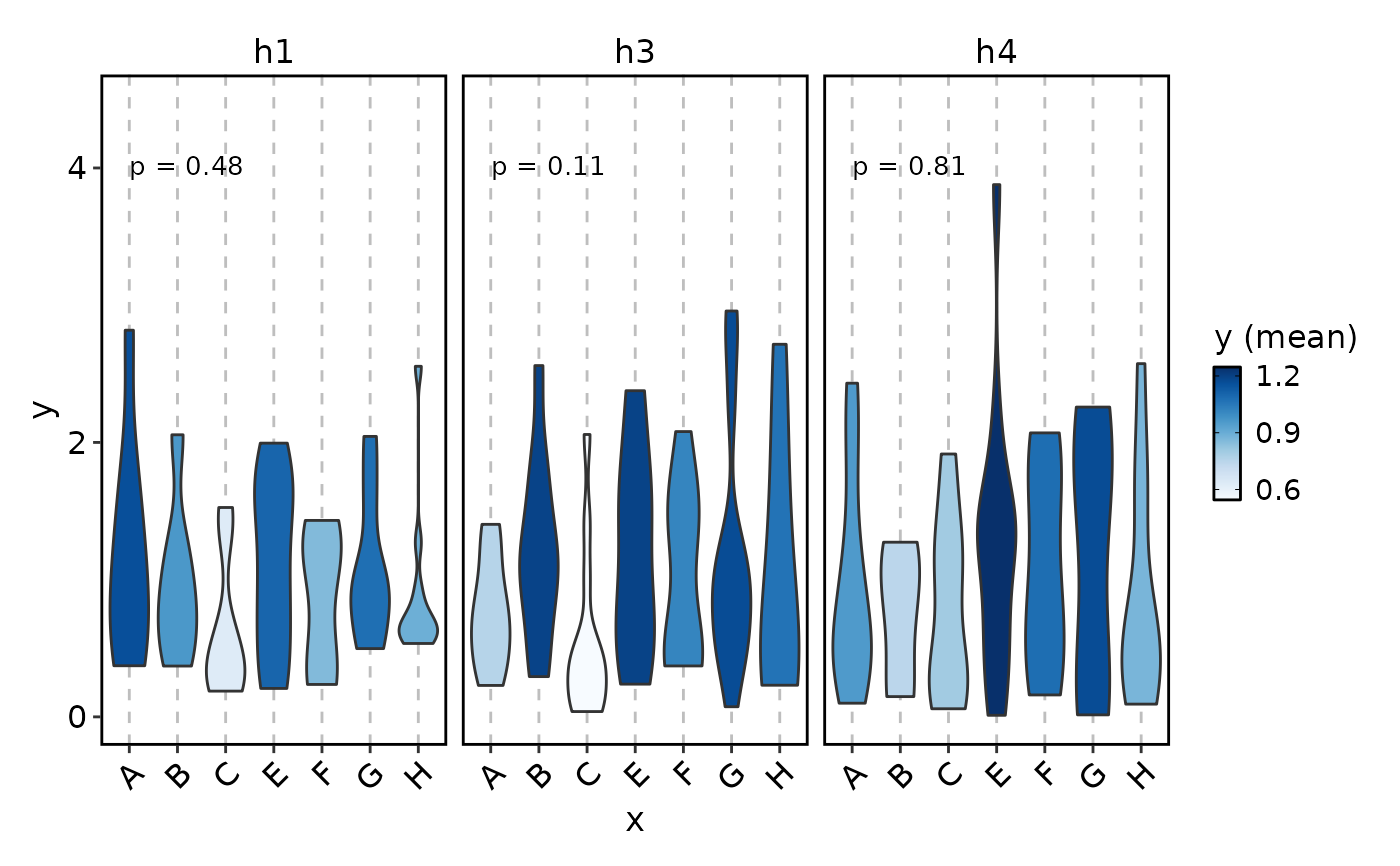 # Stacked faceting
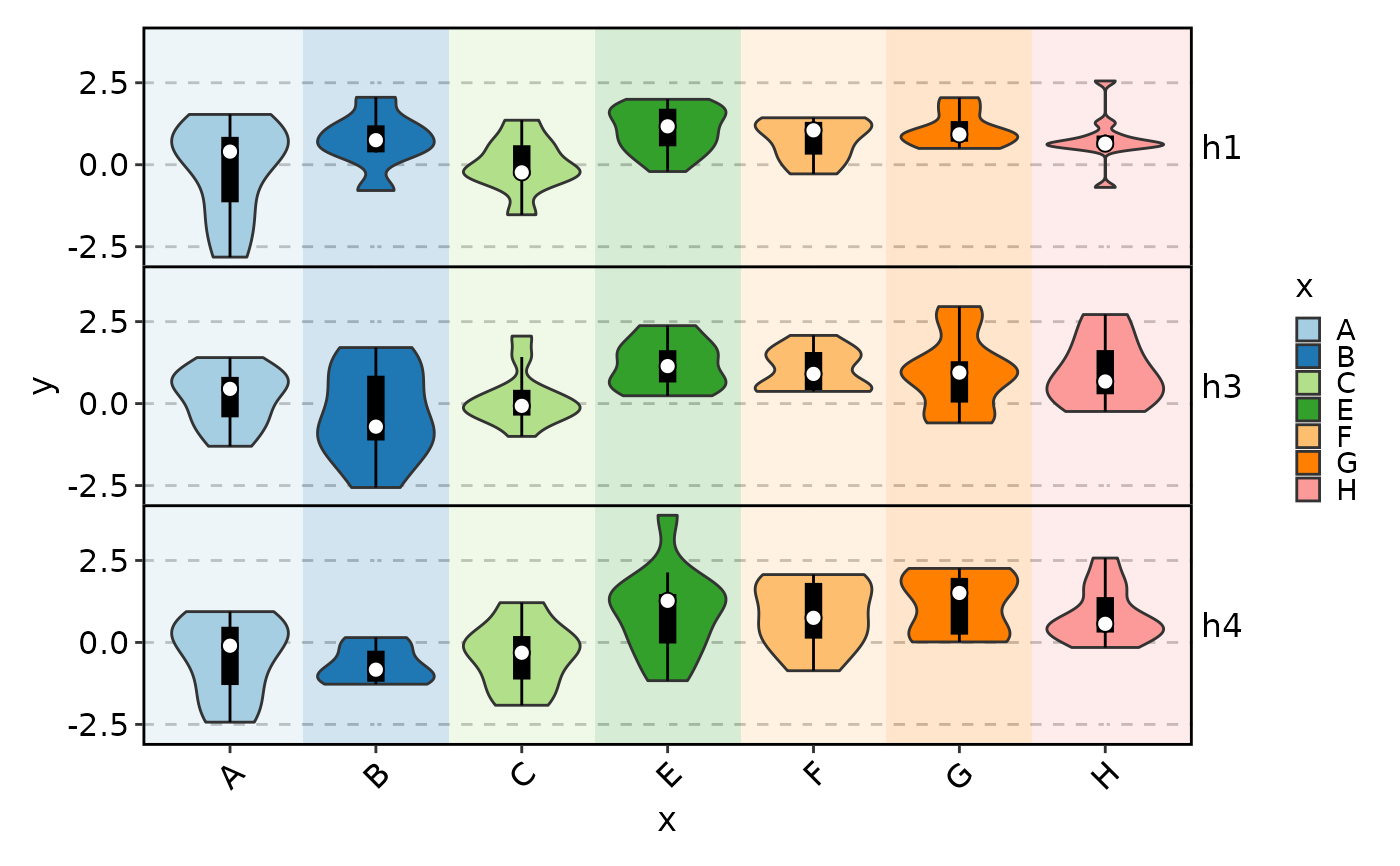
ViolinPlot(data,
x = "x", y = "y", stack = TRUE,
facet_by = "group2", add_box = TRUE, add_bg = TRUE,
bg_palette = "Paired")
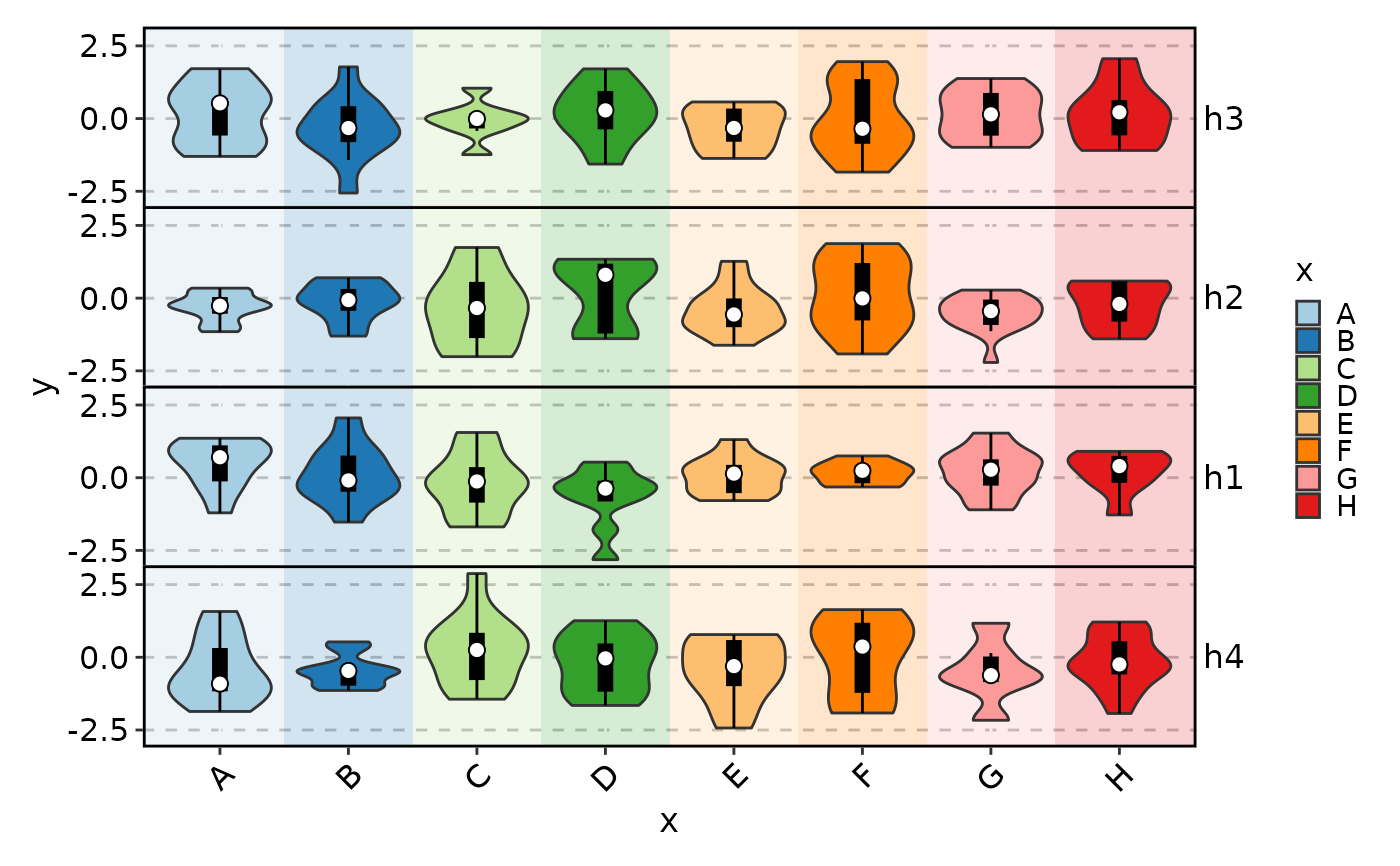
# Stacked faceting
ViolinPlot(data,
x = "x", y = "y", stack = TRUE,
facet_by = "group2", add_box = TRUE, add_bg = TRUE,
bg_palette = "Paired")
 # }
# \donttest{
# Basic beeswarm
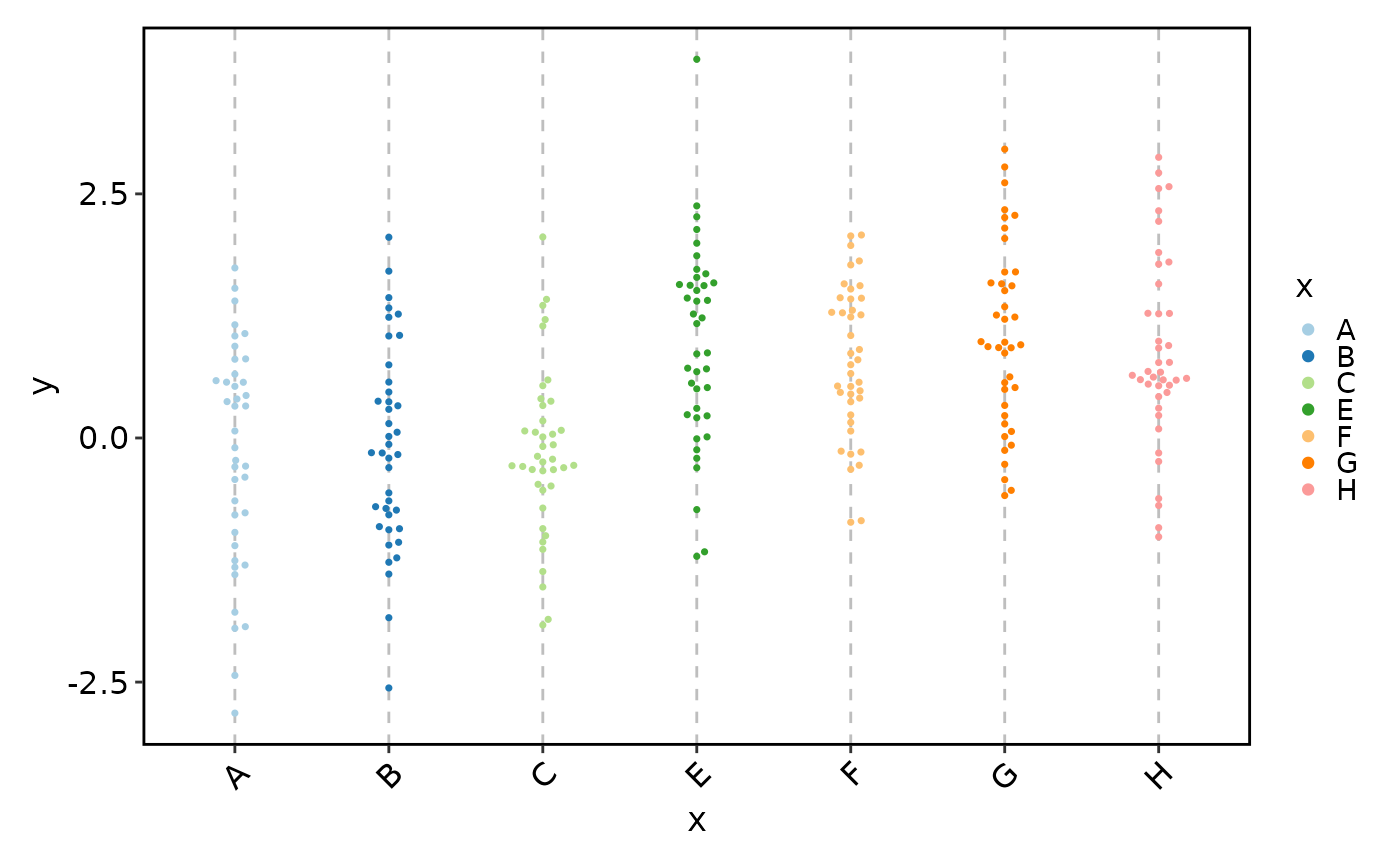
BeeswarmPlot(data, x = "x", y = "y")
# }
# \donttest{
# Basic beeswarm
BeeswarmPlot(data, x = "x", y = "y")
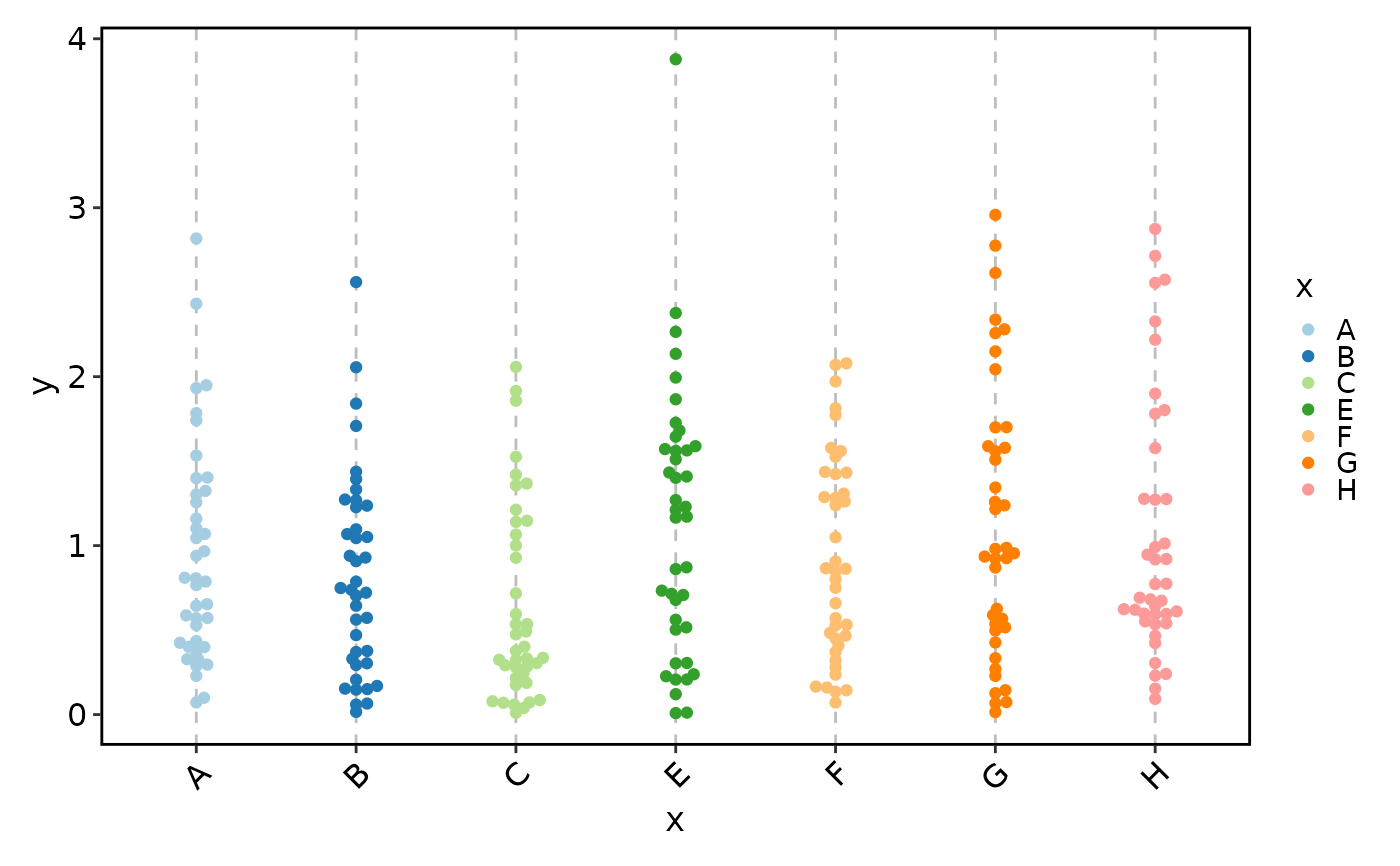
 # Control point size
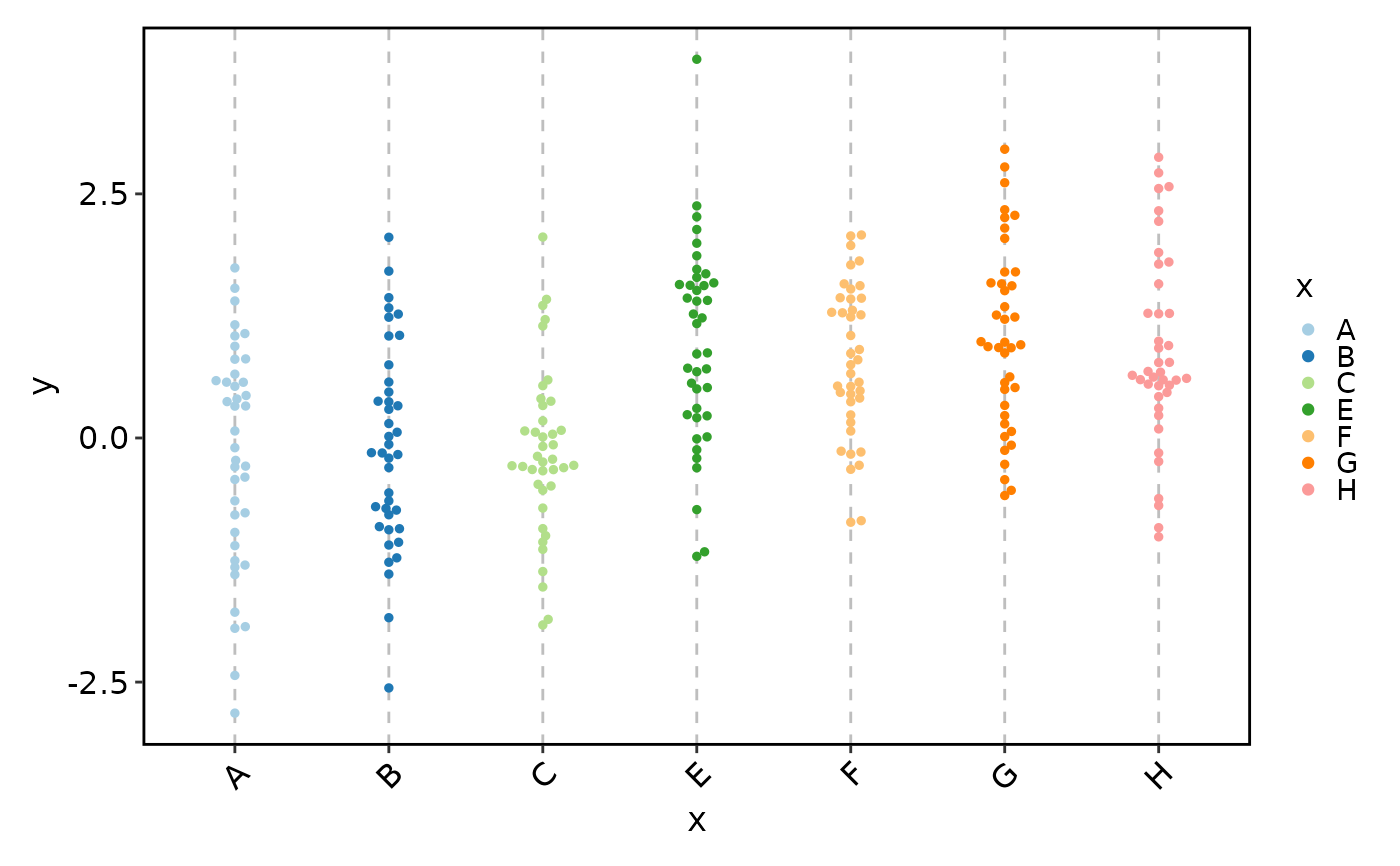
BeeswarmPlot(data, x = "x", y = "y", pt_size = 1)
# Control point size
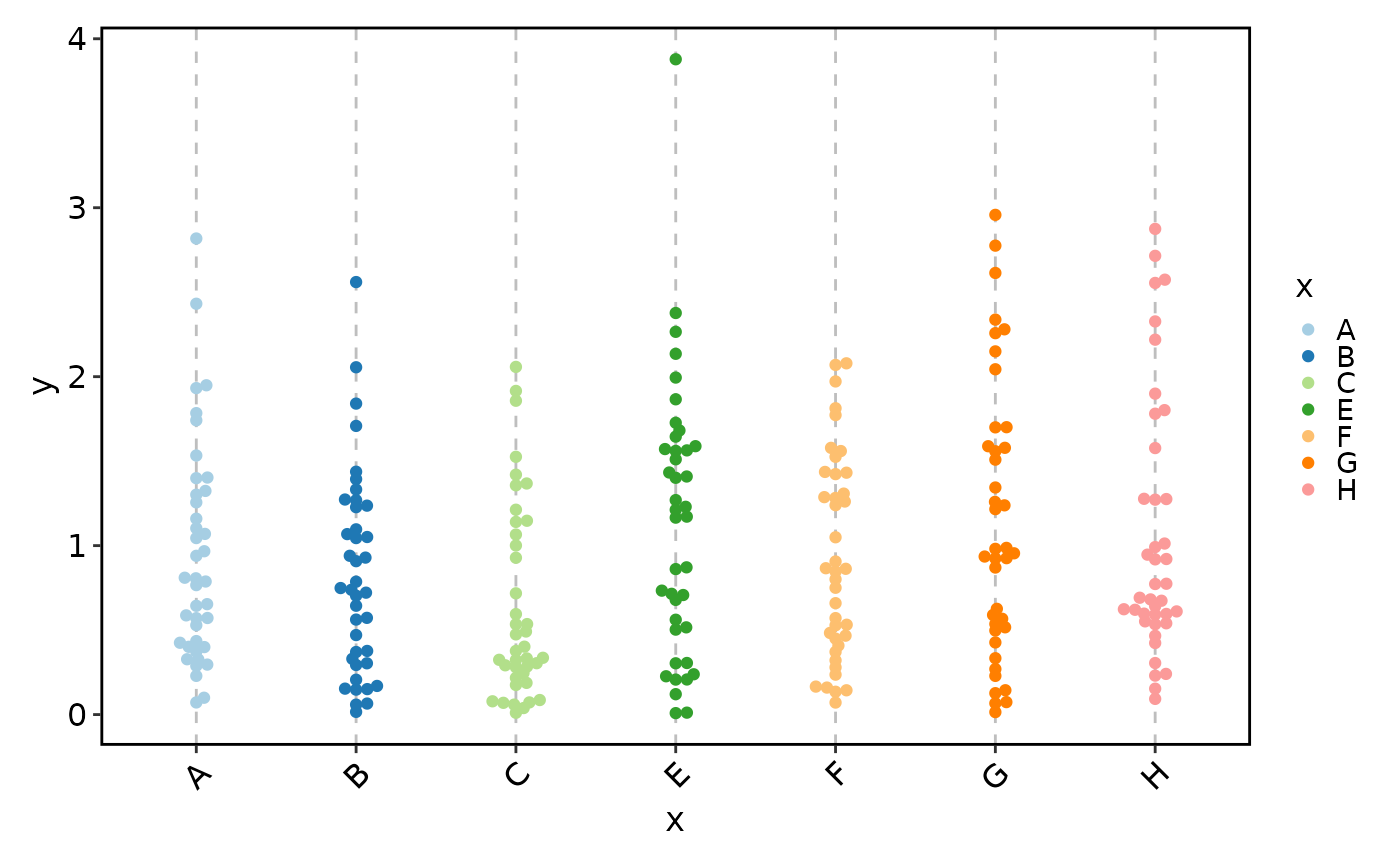
BeeswarmPlot(data, x = "x", y = "y", pt_size = 1)
 # Beeswarm with box overlay
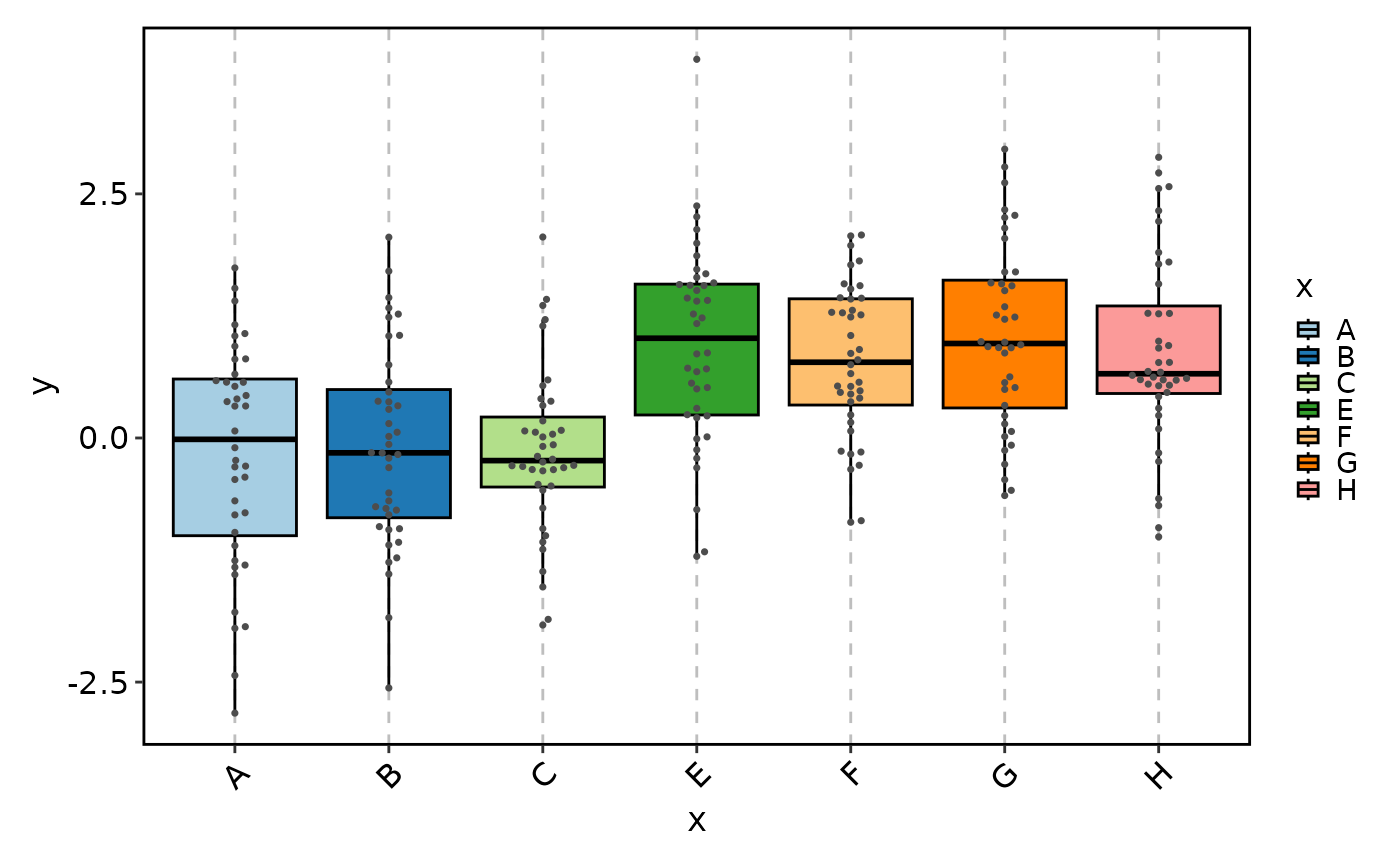
BeeswarmPlot(data, x = "x", y = "y", add_box = TRUE, pt_color = "grey30")
# Beeswarm with box overlay
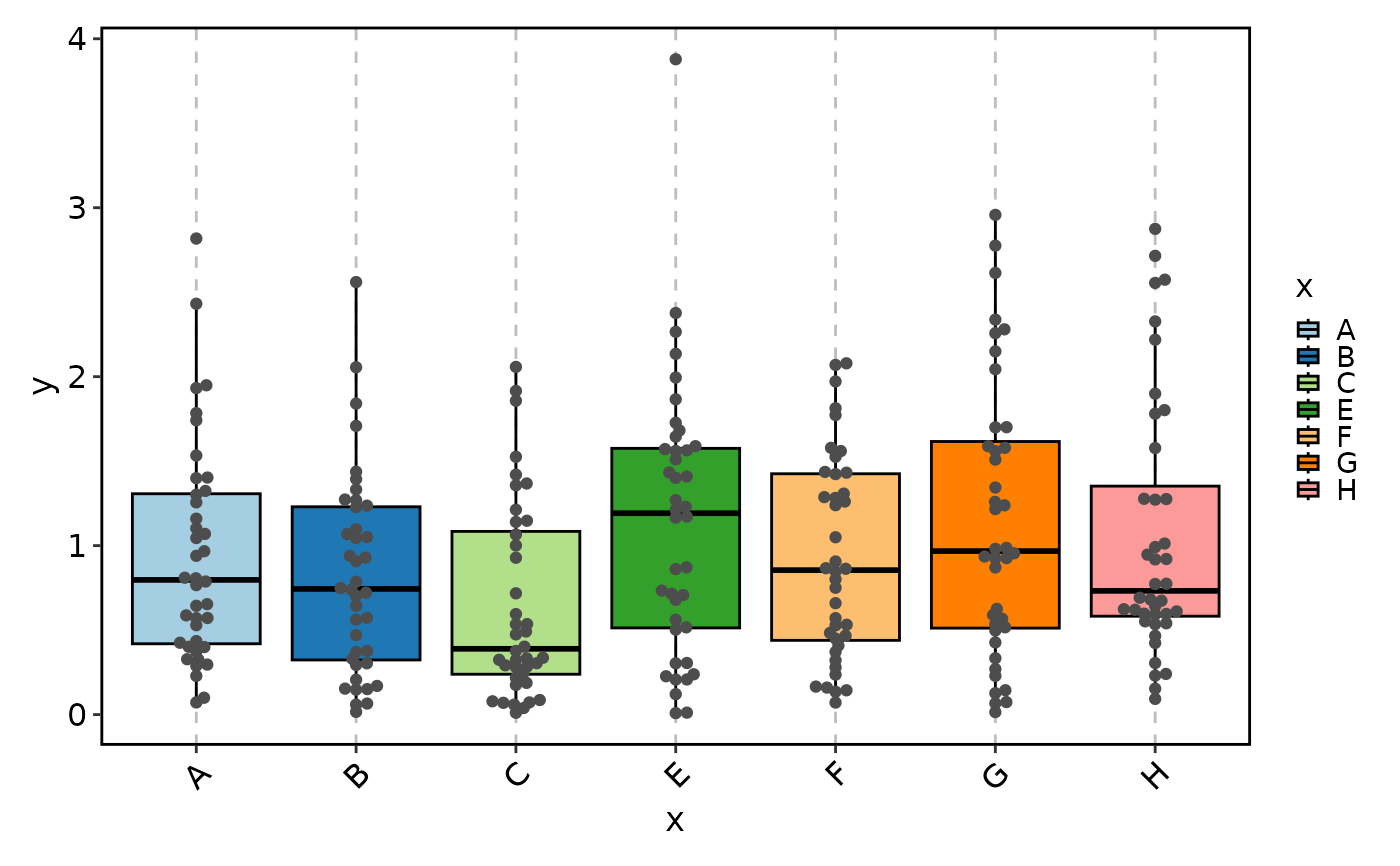
BeeswarmPlot(data, x = "x", y = "y", add_box = TRUE, pt_color = "grey30")
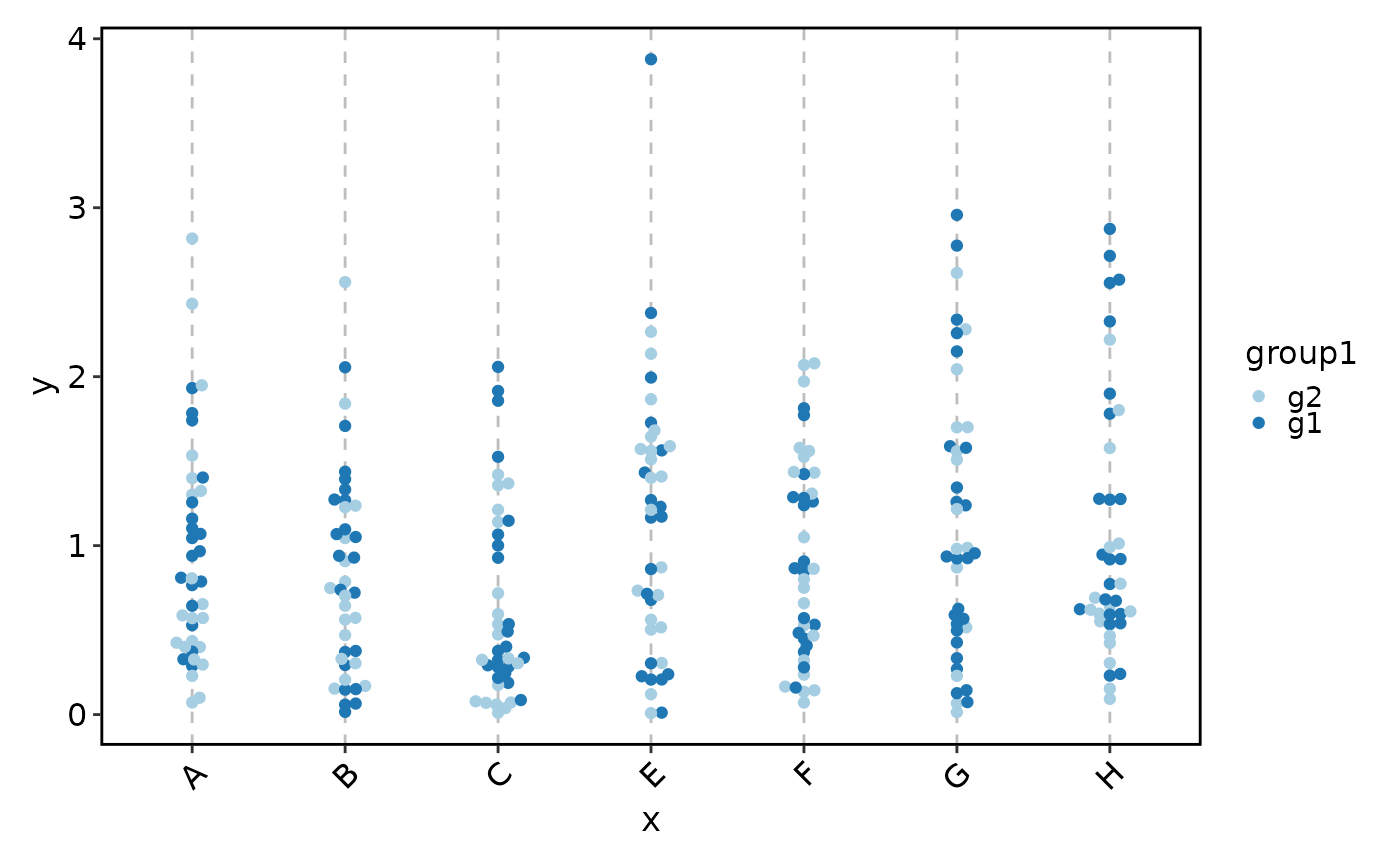
 # Grouped
BeeswarmPlot(data, x = "x", y = "y", group_by = "group1")
# Grouped
BeeswarmPlot(data, x = "x", y = "y", group_by = "group1")
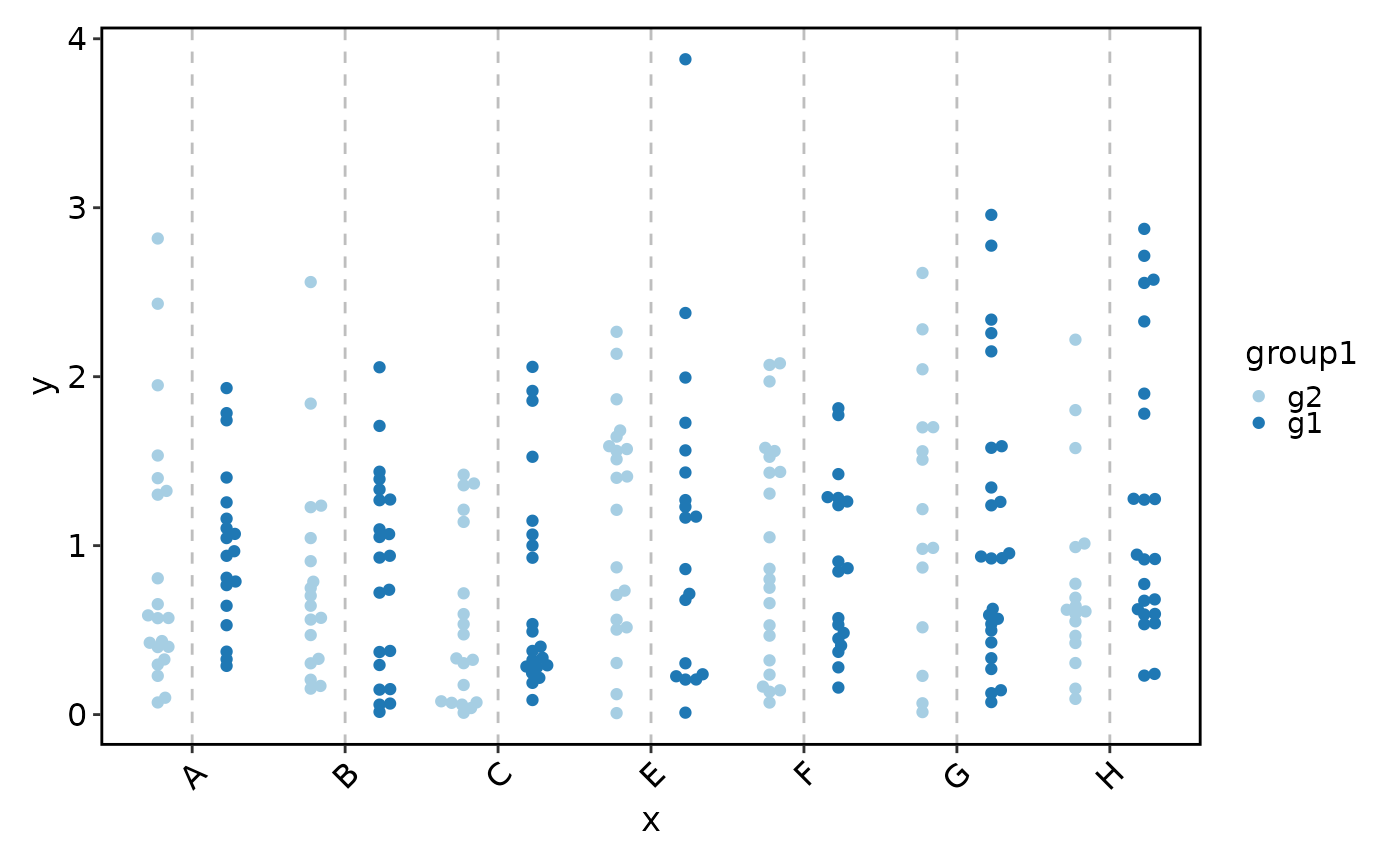
 # Grouped without dodging
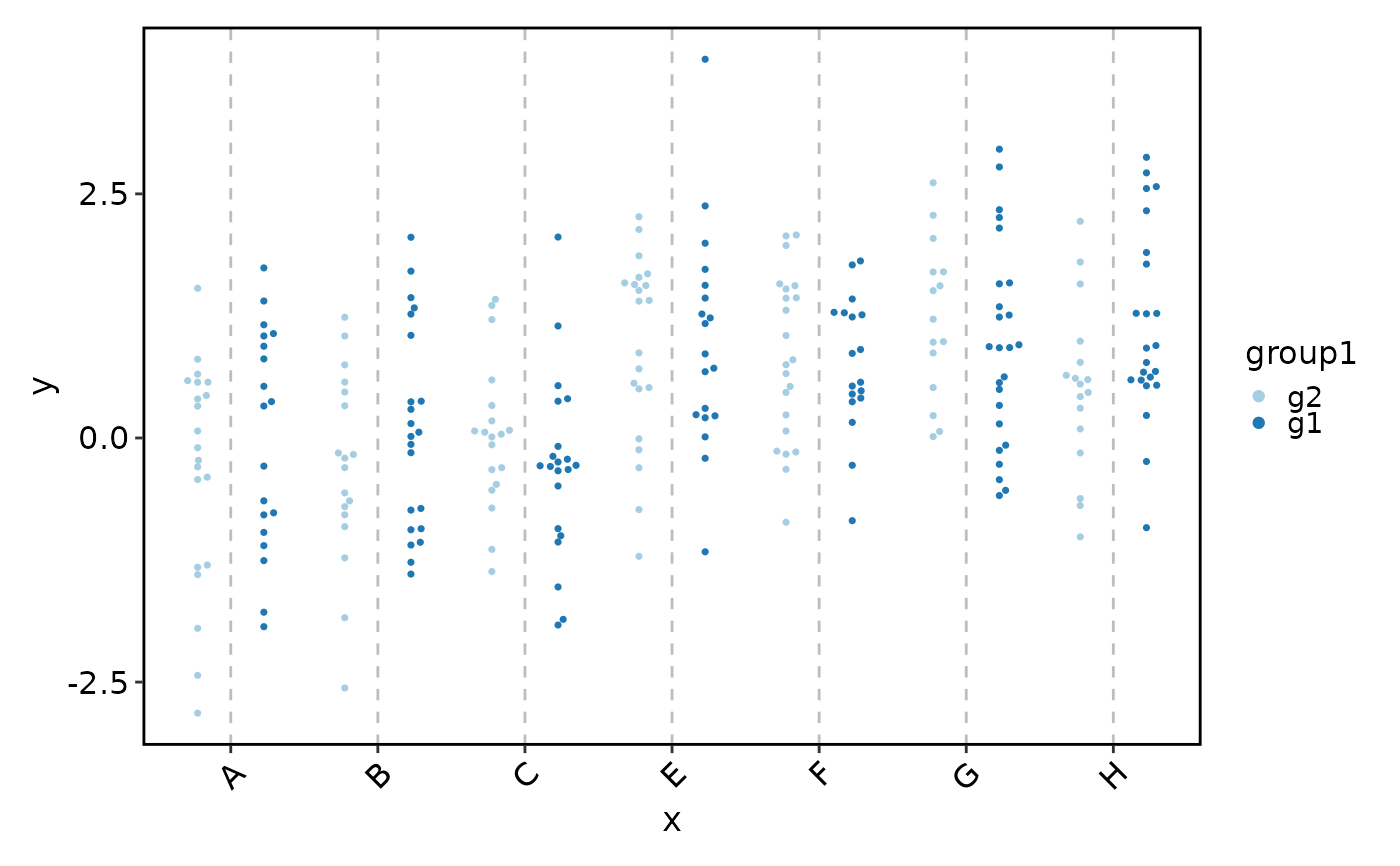
BeeswarmPlot(data, x = "x", y = "y", group_by = "group1",
beeswarm_dodge = NULL)
# Grouped without dodging
BeeswarmPlot(data, x = "x", y = "y", group_by = "group1",
beeswarm_dodge = NULL)
 # Hex layout with wider spacing
BeeswarmPlot(data,
x = "x", y = "y", beeswarm_method = "hex",
beeswarm_cex = 2)
#> Warning: In `position_beeswarm`, method `hex` discretizes the data axis (a.k.a the
#> continuous or non-grouped axis).
#> This may result in changes to the position of the points along that axis,
#> proportional to the value of `cex`.
#> To prevent this behavior, set `preserve.data.axis=TRUE`.
#> This warning is displayed once per session.
# Hex layout with wider spacing
BeeswarmPlot(data,
x = "x", y = "y", beeswarm_method = "hex",
beeswarm_cex = 2)
#> Warning: In `position_beeswarm`, method `hex` discretizes the data axis (a.k.a the
#> continuous or non-grouped axis).
#> This may result in changes to the position of the points along that axis,
#> proportional to the value of `cex`.
#> To prevent this behavior, set `preserve.data.axis=TRUE`.
#> This warning is displayed once per session.
 # }
# }