
Draws a word cloud plot that visualises word frequency and importance.
Words are displayed with font size proportional to a count variable and
colour based on a continuous score variable, using
geom_text_wordcloud for rendering.
The function supports pre-tokenised words (via word_by)
and sentence splitting (via sentence_by). Sentences are
automatically lowercased, stripped of punctuation, and split into
individual words before aggregation. Common stop words can be excluded
via words_excluded, and the number of displayed words is
controlled by top_words.
The word cloud can be faceted (via facet_by) or
split into separate sub-plots via split_by. When
split_by is used, each split level receives its own word cloud,
and the results are combined into a single layout via
combine_plots.
Usage
WordCloudPlot(
  data,
  word_by = NULL,
  sentence_by = NULL,
  count_by = NULL,
  score_by = NULL,
  count_name = NULL,
  score_name = NULL,
  split_by = NULL,
  split_by_sep = "_",
  words_excluded = plotthis::words_excluded,
  score_agg = mean,
  minchar = 2,
  word_size = c(2, 8),
  top_words = 100,
  facet_by = NULL,
  facet_scales = "fixed",
  facet_ncol = NULL,
  facet_nrow = NULL,
  facet_byrow = TRUE,
  theme = "theme_this",
  theme_args = list(),
  palette = "Spectral",
  palcolor = NULL,
  alpha = 1,
  palreverse = FALSE,
  aspect.ratio = 1,
  legend.position = "right",
  legend.direction = "vertical",
  title = NULL,
  subtitle = NULL,
  seed = 8525,
  combine = TRUE,
  nrow = NULL,
  ncol = NULL,
  byrow = TRUE,
  axes = NULL,
  axis_titles = axes,
  guides = NULL,
  design = NULL,
  ...
)
Arguments
- data
A data frame.
- word_by
A character string specifying the column name containing pre-tokenized words. A character column is expected. Use this when your data already has one word per row (or a list of words per row). Mutually exclusive with
sentence_by.- sentence_by
A character string specifying the column name containing sentences or phrases to be split into individual words. A character column is expected. The text is lowercased and punctuation is removed before splitting on whitespace boundaries. Mutually exclusive with
word_by.- count_by
A character string specifying the numeric column for the count or frequency of each word. When
NULL(the default), each occurrence counts as 1. Must beNULLwhensentence_byis used, as counts are derived from the number of occurrences after splitting.- score_by
A character string specifying the numeric column for the score of each word, mapped to the text colour via a continuous gradient. When
NULL(the default), all words receive a score of 1 and are coloured at the low end of the palette.- count_name
A character string for the size legend title. When
NULL(the default),"Count"is used.- score_name
A character string for the colour-bar legend title. When
NULL(the default),"Score"is used.- split_by
The column(s) to split data by and plot separately. When
combine = TRUE, the combined plot's data (p$data) contains the rows of every split, tagged with thesplit_bycolumn. For ggraph-based plots (e.g.Network,ClustreePlot), the node layout of every split is exposed with the split column, and the original link rows (also tagged with thesplit_bycolumn) are available as the"edges"attribute of the data.- split_by_sep
The separator for multiple split_by columns. See
split_by- words_excluded
A character vector of words to exclude from the word cloud. Matching is case-insensitive. Defaults to
plotthis::words_excluded, a built-in set of common English stop words.- score_agg
A function to aggregate the scores when multiple observations of the same word exist. Default is
mean. Other options includesum,median, or a custom function.- minchar
A numeric value specifying the minimum number of characters a word must have to be included. Words with fewer characters are filtered out. Default:
2.- word_size
A numeric vector of length 2 specifying the range of font sizes (in mm) for the words. Passed to
scale_size(range =
word_size)
. Default:c(2, 8).- top_words
A numeric value specifying the maximum number of words to display, selected by highest score. Default:
100.- facet_by
A character string specifying the column name of the data frame to facet the plot. Otherwise, the data will be split by
split_byand generate multiple plots and combine them into one usingpatchwork::wrap_plots- facet_scales
Whether to scale the axes of facets. Default is "fixed" Other options are "free", "free_x", "free_y". See
ggplot2::facet_wrap- facet_ncol
A numeric value specifying the number of columns in the facet. When facet_by is a single column and facet_wrap is used.
- facet_nrow
A numeric value specifying the number of rows in the facet. When facet_by is a single column and facet_wrap is used.
- facet_byrow
A logical value indicating whether to fill the plots by row. Default is TRUE.
- theme
A character string or a theme class (i.e. ggplot2::theme_classic) specifying the theme to use. Default is "theme_this".
- theme_args
A list of arguments to pass to the theme function.
- palette
A character string specifying the palette to use. A named list or vector can be used to specify the palettes for different
split_byvalues.- palcolor
A character string specifying the color to use in the palette. A named list can be used to specify the colors for different
split_byvalues. If some values are missing, the values from the palette will be used (palcolor will be NULL for those values).- alpha
A numeric value specifying the transparency of the plot.
- palreverse
A logical value indicating whether to reverse the palette. Default is FALSE.
- aspect.ratio
A numeric value specifying the aspect ratio of the plot.
- legend.position
A character string specifying the position of the legend. if
waiver(), for single groups, the legend will be "none", otherwise "right".- legend.direction
A character string specifying the direction of the legend.
- title
A character string specifying the title of the plot. A function can be used to generate the title based on the default title. This is useful when split_by is used and the title needs to be dynamic.
- subtitle
A character string specifying the subtitle of the plot.
- seed
The random seed to use. Default is 8525.
- combine
Whether to combine the plots into one when facet is FALSE. Default is TRUE.
- nrow
A numeric value specifying the number of rows in the facet.
- ncol
A numeric value specifying the number of columns in the facet.
- byrow
A logical value indicating whether to fill the plots by row.
- axes
A string specifying how axes should be treated. Passed to
patchwork::wrap_plots(). Only relevant whensplit_byis used andcombineis TRUE. Options are:'keep' will retain all axes in individual plots.
'collect' will remove duplicated axes when placed in the same run of rows or columns of the layout.
'collect_x' and 'collect_y' will remove duplicated x-axes in the columns or duplicated y-axes in the rows respectively.
- axis_titles
A string specifying how axis titltes should be treated. Passed to
patchwork::wrap_plots(). Only relevant whensplit_byis used andcombineis TRUE. Options are:'keep' will retain all axis titles in individual plots.
'collect' will remove duplicated titles in one direction and merge titles in the opposite direction.
'collect_x' and 'collect_y' control this for x-axis titles and y-axis titles respectively.
- guides
A string specifying how guides should be treated in the layout. Passed to
patchwork::wrap_plots(). Only relevant whensplit_byis used andcombineis TRUE. Options are:'collect' will collect guides below to the given nesting level, removing duplicates.
'keep' will stop collection at this level and let guides be placed alongside their plot.
'auto' will allow guides to be collected if a upper level tries, but place them alongside the plot if not.
- design
Specification of the location of areas in the layout, passed to
patchwork::wrap_plots(). Only relevant whensplit_byis used andcombineis TRUE. When specified,nrow,ncol, andbyroware ignored. Seepatchwork::wrap_plots()for more details.- ...
Additional arguments.
Value
A ggplot object (when no split_by is used), a
patchwork object (when combine = TRUE and
split_by is used), or a named list of ggplot objects
(when combine = FALSE), each with height and
width attributes in inches.
split_by workflow
When split_by is provided:
validate_common_args()validates theseedandfacet_byconstraints (maximum 2 facet columns).The
themeargument is resolved viaprocess_theme().The
split_bycolumn(s) are validated and transformed viacheck_columns()withforce_factor = TRUEandconcat_multi = TRUE.The data frame is split by
split_by(preserving factor level order). Ifsplit_byisNULL, the data is wrapped in a single-element list with name"...".Per-split
palette,palcolor,legend.position, andlegend.directionare resolved viacheck_palette(),check_palcolor(), andcheck_legend().WordCloudPlotAtomic()is called for each split. Iftitleis a function, it receives the split level name and can generate dynamic titles per sub-plot.Results are combined via
combine_plots()(whencombine = TRUE) or returned as a named list (whencombine = FALSE).
Examples
# \donttest{
set.seed(8525)
data <- data.frame(
word = c("apple", "banana", "cherry", "date", "elderberry",
"fig", "grape", "honeydew", "kiwi", "lemon"),
count = c(10, 20, 30, 40, 50, 15, 25, 35, 45, 55),
score = c(1, 2, 3, 4, 5, 1.5, 2.5, 3.5, 4.5, 5.5),
facet = rep(c("Group1", "Group2"), each = 5),
split = rep(c("A", "B"), 5)
)
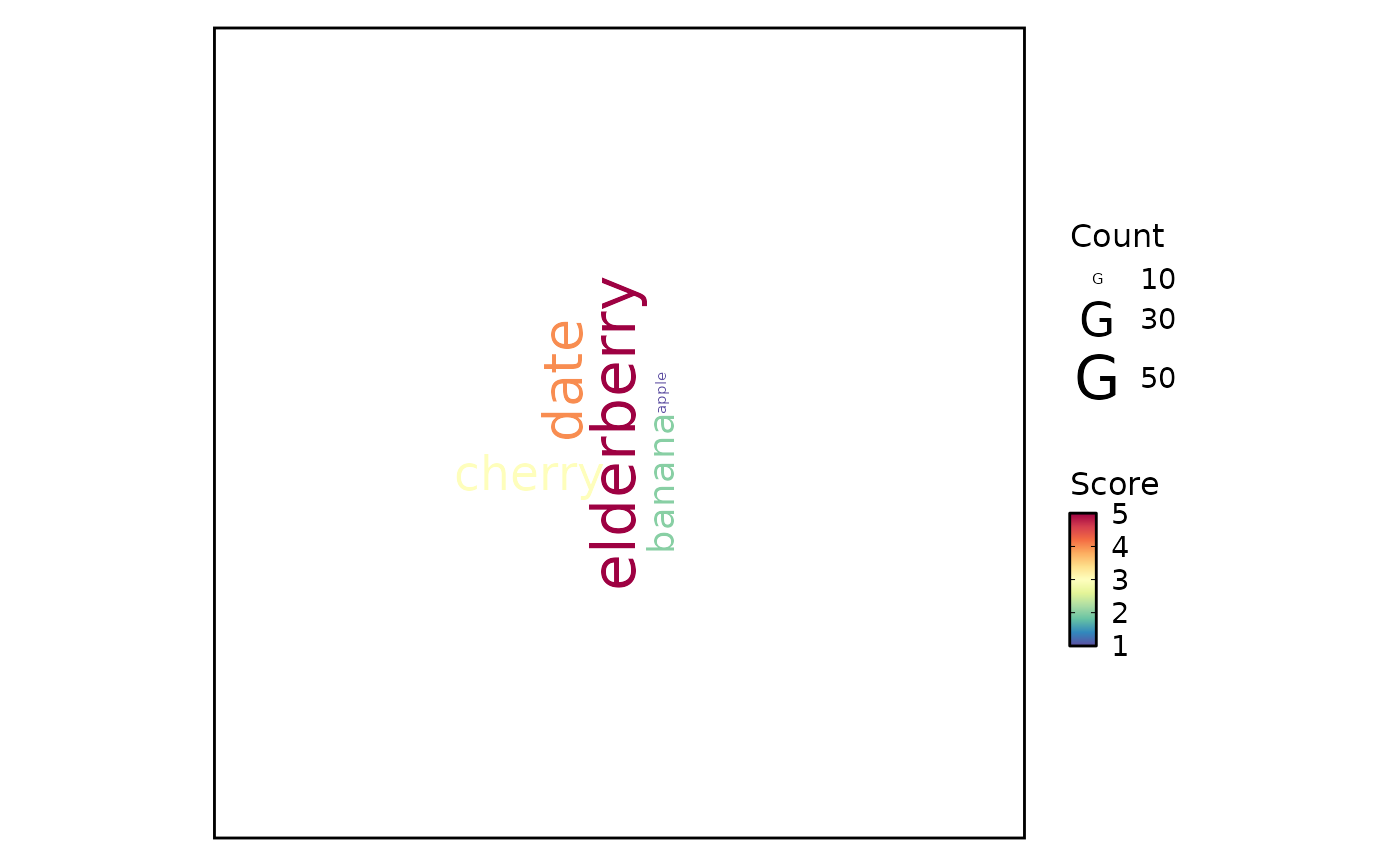
# Basic word cloud with word, count, and score columns
WordCloudPlot(data, word_by = "word",
count_by = "count", score_by = "score")
 # Word cloud using sentence_by (sentences split into words)
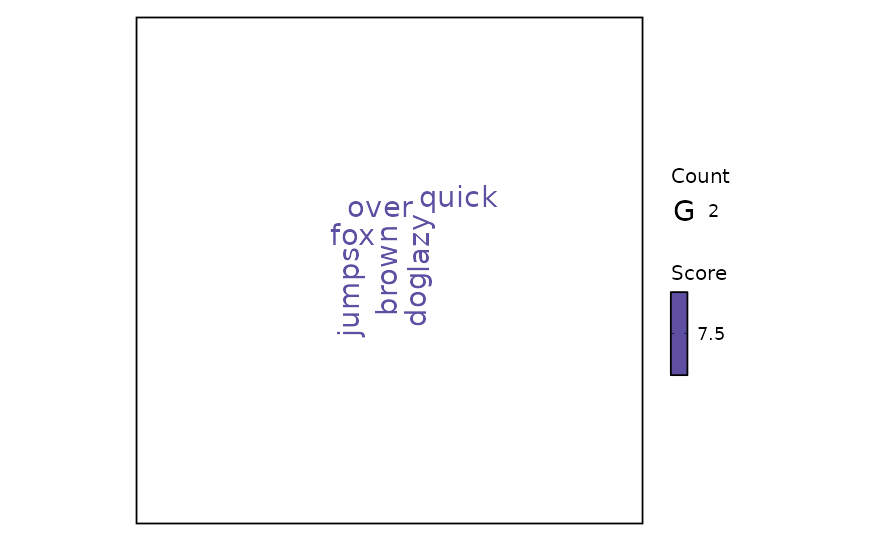
data_sent <- data.frame(
sentence = c("The quick brown fox jumps over the lazy dog",
"A quick brown dog jumps over a lazy fox"),
score = c(10, 5)
)
WordCloudPlot(data_sent, sentence_by = "sentence", score_by = "score")
# Word cloud using sentence_by (sentences split into words)
data_sent <- data.frame(
sentence = c("The quick brown fox jumps over the lazy dog",
"A quick brown dog jumps over a lazy fox"),
score = c(10, 5)
)
WordCloudPlot(data_sent, sentence_by = "sentence", score_by = "score")
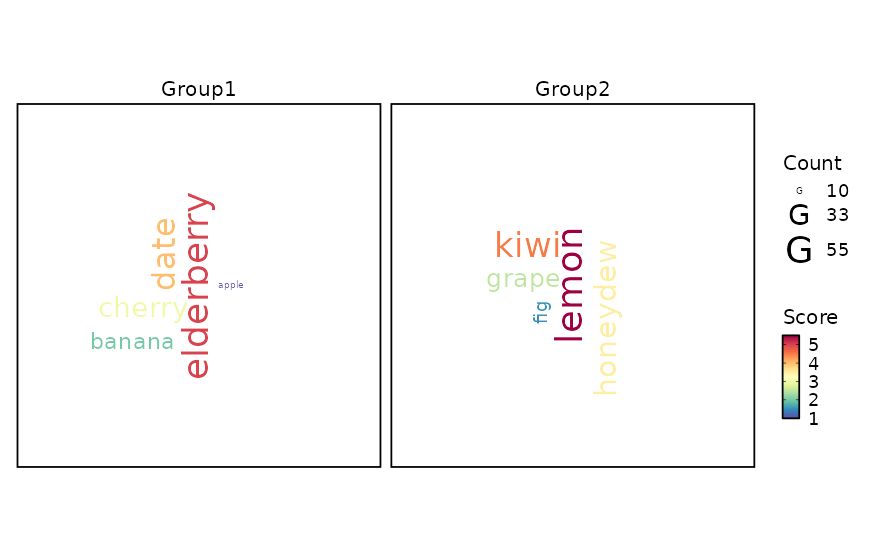
 # Word cloud with faceting
WordCloudPlot(data, word_by = "word",
count_by = "count", score_by = "score",
facet_by = "facet")
# Word cloud with faceting
WordCloudPlot(data, word_by = "word",
count_by = "count", score_by = "score",
facet_by = "facet")
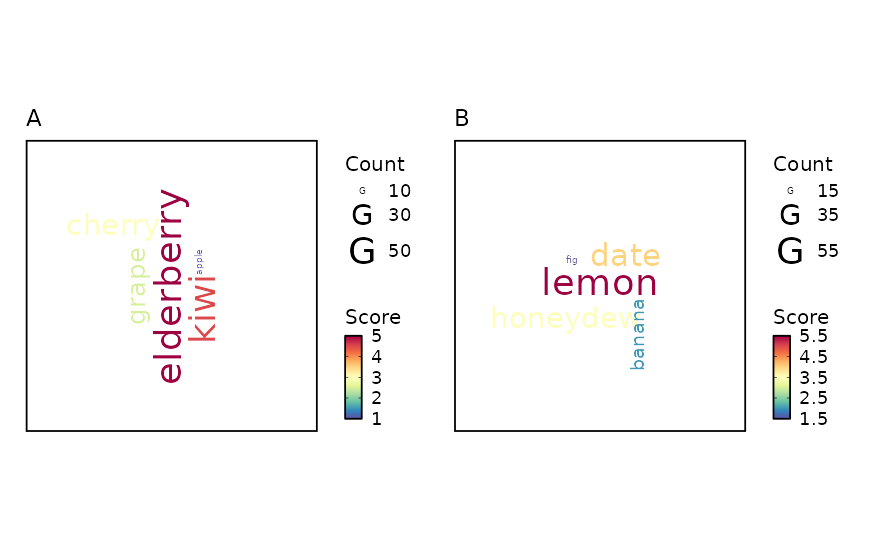
 # Word cloud split by a grouping variable
WordCloudPlot(data, word_by = "word",
count_by = "count", score_by = "score",
split_by = "split")
# Word cloud split by a grouping variable
WordCloudPlot(data, word_by = "word",
count_by = "count", score_by = "score",
split_by = "split")
 # }
# }